E-E-A-T for Healthcare Websites: A Practical Checklist
If you run marketing for a clinic, you already care about getting health information right. This guide shows how to make that care visible to patients, Google and AI assistants, page by page.
 By Noor Khan
Key takeaways
- E-E-A-T is Experience, Expertise, Authoritativeness and Trust. Google calls trust the most important member of the family.
- Health is a YMYL topic, so Google's raters hold it to the highest standard of page quality.
- Google says E-E-A-T is not a single ranking factor. Its systems use a mix of signals that point to it, so you earn it rather than optimize for it.
- Patients check: 58.5% of US adults looked online for health information in late 2022, and a 2025 vendor survey found 84% of patients check reviews before choosing a provider.
- Show a named, credentialed reviewer and an honest review date on every clinical page, and only change that date when a clinician actually reviews the page.
- Schema such as MedicalWebPage, reviewedBy and lastReviewed makes your review process machine-readable. It supports trust; it is not a ranking lever.
Part of the Addiction Treatment SEO: How Rehab Centers Win Admissions from Search series.
If you market a clinic, a practice or a treatment center, you already care about getting health information right. The trouble is that care is invisible unless you show it. A patient, a Google quality rater and an AI assistant all see the same thing: a page, with or without clear signs of who stands behind it.
That's what E-E-A-T is about. In this guide I'll explain what Google's guidelines actually say about health content, map each part of E-E-A-T to the pages a clinic really has, walk through the medical review workflow I set up with healthcare clients, and finish with a checklist you can print and work through with your team.
By the numbers
Patients research care online, and they read what others say about you. These are the figures I keep coming back to:
| Figure | What it means | Source |
|---|---|---|
| 58.5% | of US adults used the internet to look for health or medical information (July to December 2022) | CDC NCHS Data Brief 482 (2023) |
| 84% | of patients check online reviews before choosing a new provider | Rater8 survey reported by Medical Economics (2025) |
| 51% | of patients read six or more reviews before deciding | Rater8 survey reported by Medical Economics (2025) |
| 1 in 20 | Google searches were for health information, Google said when it launched doctor-reviewed health panels | TechCrunch (2015) |
| About 42% | of 300+ sites submitted to a survey after Google's August 2018 core update were in health, medical or fitness | Search Engine Roundtable (2018) |
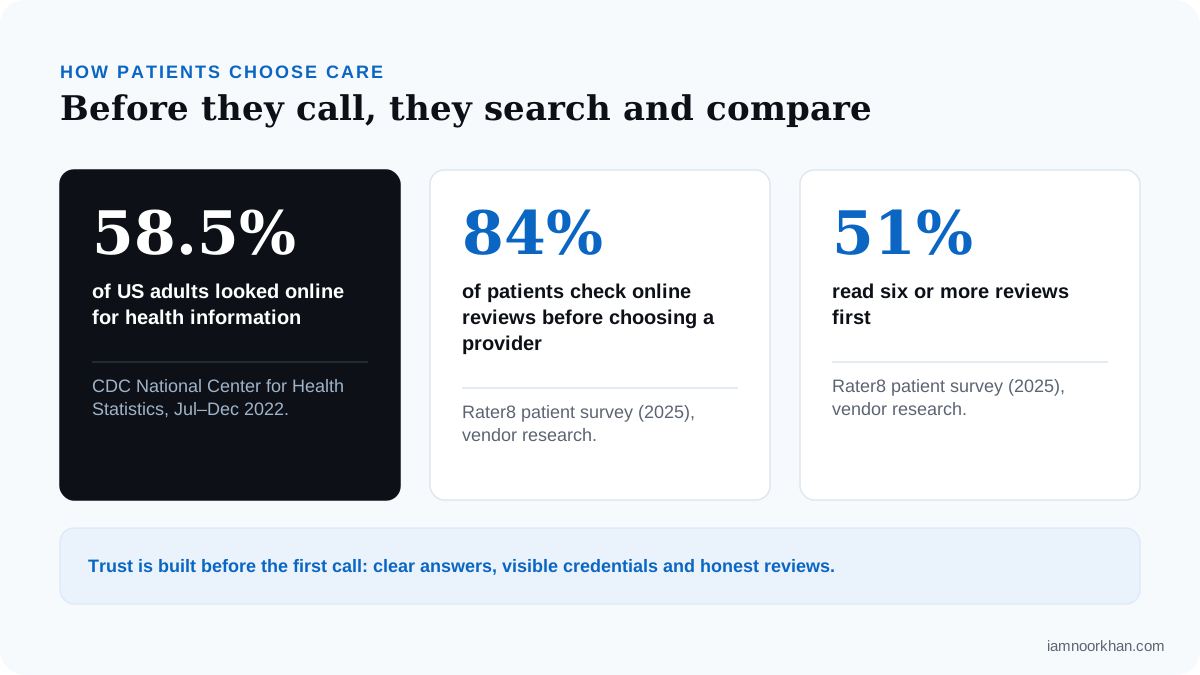
Two notes on those numbers. The Rater8 figures come from a vendor survey of just over 1,000 US patients, so treat them as a strong signal rather than a census. And the 2015 "1 in 20" figure is old, but it tells you how long Google has treated health search as a special case.
What Google's guidelines say about health content
Google judges health content by its strictest standard because getting it wrong can hurt people. The detail lives in the Search Quality Rater Guidelines, the manual Google gives the human raters who evaluate search results. The current public edition is dated September 11, 2025, which Search Engine Roundtable reported (2025) as a minor update with clarifications to YMYL rating and new examples.
Three ideas from Google matter most for a clinic.
Health is a YMYL topic
YMYL means "Your Money or Your Life": topics where content "could significantly impact the health, financial stability, or safety of people, or the welfare or well-being of society," as the rater guidelines put it (quoted in Search Engine Land's YMYL guide). Medical, mental health and addiction treatment pages are squarely inside that definition, so raters expect the highest level of trust.
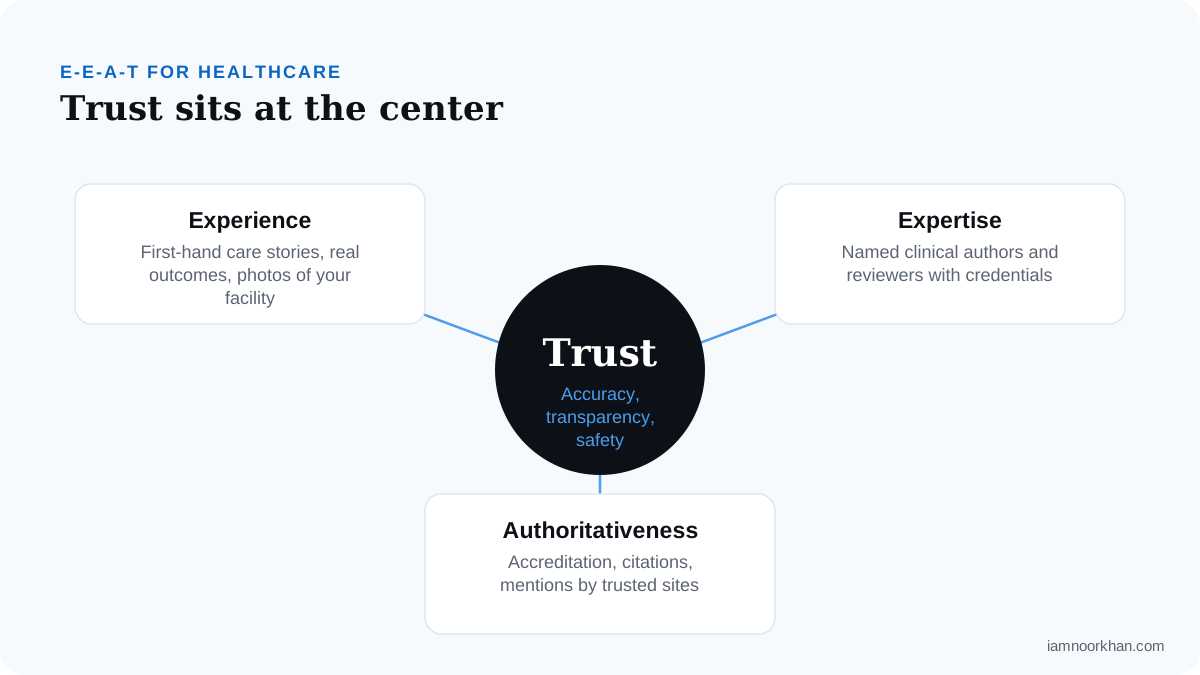
Trust is the center of E-E-A-T
Google added the extra "E" for Experience in December 2022, and in the same announcement called trust "the most important member of the E-E-A-T family" (Google Search Central Blog (2022)). Experience means first-hand involvement: having actually done or lived the thing you write about.
E-E-A-T is a quality, not a setting
Google is explicit that "E-E-A-T itself isn't a specific ranking factor," but that its systems use "a mix of factors that can identify content with good E-E-A-T" (Google Search Central: Creating helpful, reliable, people-first content). Raters don't change rankings directly either: their scores help Google evaluate whether its systems are working.
Two myths to drop before you start
Myth: "We need to raise our E-E-A-T score." There is no score. Google has said E-E-A-T isn't a specific ranking factor. You can't install it with a plugin; you build the real qualities and make them easy to see.
Myth: "The Medic update was a penalty with a fix." The August 2018 core update hit many health sites hard, which is why Barry Schwartz nicknamed it "Medic". But Google's Danny Sullivan said at the time there was no specific fix for sites that dropped (Search Engine Roundtable (2018)). The lasting answer was, and still is, better and more trustworthy content.
E-E-A-T mapped to the pages a clinic actually has
Every page type on a clinic website can show E-E-A-T, but each shows it differently. This is the table I use when auditing a healthcare site:
| Page type | Experience | Expertise | Authoritativeness | Trust |
|---|---|---|---|---|
| Provider bio | Years in practice, populations served, the clinician's own words on how they work | Degrees, board certification, licence type and number | Hospital affiliations, professional memberships, publications | Real photo, licence verifiable on the state board, consistent details across profiles |
| Service or treatment page | What a first visit or a typical week actually looks like at your clinic | Clinical description written or reviewed by a named clinician | Accreditation relevant to the service (for example, The Joint Commission or CARF) | Honest eligibility, insurance and cost information; no outcome promises |
| Condition page | Common questions your clinicians hear, answered plainly | Medically reviewed, with reviewer name, credentials and date | Citations to government health agencies, professional bodies and peer-reviewed research | Clear "when to seek urgent care" guidance; review date that means something |
| Blog article | Clinician perspective, anonymized patterns from practice (never identifiable patient details) | Author bio and clinical reviewer | Mentions or links from reputable health organizations | Sources listed; corrections policy |
| Location page | Real photos of the building, rooms and team | Which clinicians practice at this location | Local accreditation and memberships | Address, hours, phone, accessibility and parking, matching your Google Business Profile |
| About and policies | Your history and why you do this work | Clinical leadership team | Awards, accreditation, community partnerships | Editorial and medical review policy, privacy policy, ownership and contact details |
You don't need everything in every cell on day one. Start with the cells that are empty on your highest-traffic pages.
The medical review workflow I set up with clients
A medical review workflow is a repeatable process where every clinical page is drafted, checked by a named clinician, edited, published with visible review details, and re-reviewed on a schedule. Writing it down is what turns "we're careful" into something a patient or a rater can see.
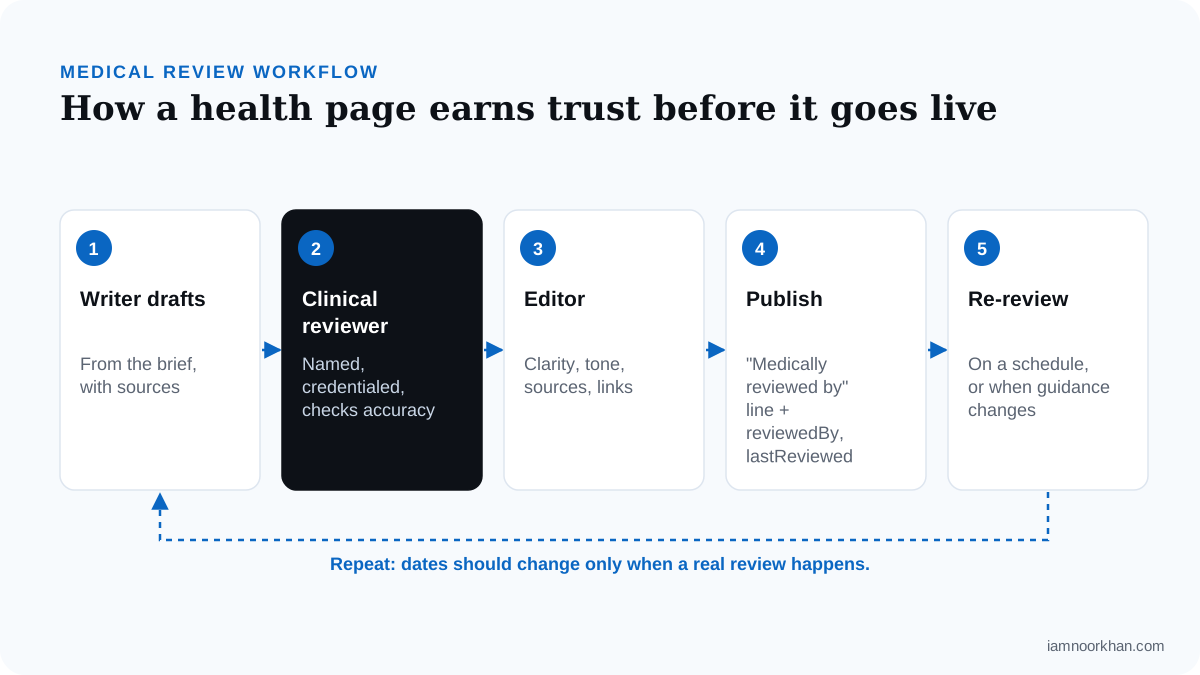
- The writer drafts. A health writer or marketer drafts the page from a brief, citing sources for every clinical claim.
- A clinical reviewer checks accuracy. A named clinician with credentials relevant to the topic reviews the draft. A psychiatrist reviews medication content; an LCSW might review a page on family therapy.
- An editor checks clarity and sources. The editor confirms the page answers the patient's question in plain language, that sources are current and that nothing promises outcomes.
- Publish with visible review details. The page shows a "Medically reviewed by [Name, credentials] on [date]" line linking to the reviewer's bio, and the same details go into
reviewedByandlastReviewedmarkup. - Re-review on a schedule. Every 12 months is a sensible default for clinical pages, and sooner when guidance, regulations or your services change.
Here's what step 4 looks like before and after, on a real-world style condition page:
| Before | After |
|---|---|
| "By Admin · Updated 3 days ago" | "Written by Jordan Lee, health writer. Medically reviewed by Dr. A. Patel, MD, board-certified psychiatrist, on March 4, 2026." |
| No sources | Five citations to government health agencies and peer-reviewed research, listed at the end |
| Stock photo of a smiling model | Photo of your actual treatment room |
| No way to report an error | "Spotted something out of date? Tell us" link to a corrections page |
(The names above are placeholders, not real people. Use your own clinicians, with their permission.)
Dates must mean something
A review date is a promise that a clinician checked the page on that day. Changing "last updated" every week without a clinical review is a habit I see often, and it quietly undermines the very trust the date is meant to show.
My rules for clients are simple:
- Change
lastReviewedonly after a real clinical review, and keep a record of who reviewed what and when. - Show "updated" separately if you made non-clinical edits, such as fixing a typo or a phone number.
- Never bulk-refresh dates across the site. If a page hasn't been reviewed in two years, the honest fix is to review it, not to relabel it.
If you work in behavioral health, the stakes here are even higher. I cover the wider setup for treatment centers in my addiction treatment SEO guide.
Reviews: trust signals you handle privately
Online reviews are one of the first trust signals patients see, and how you respond to them is part of your E-E-A-T. In the same Rater8 survey, 45% of patients said a provider's response to reviews would influence their choice, and 40% said negative reviews had led them to cancel or not book (Medical Economics (2025)).
The catch for healthcare is privacy. In the US, HIPAA generally means you can't confirm that someone is a patient, even when they've named themselves in a public review. I'm not a lawyer, and this isn't legal advice: check your response approach with your compliance team. What I recommend is a response pattern that is warm, general and moves the conversation offline:
"Thank you for taking the time to share this. We take every concern seriously and would welcome the chance to talk. Please call our patient experience team at [number] so we can help."
That reply never confirms a visit, a diagnosis or a treatment, and it shows every future reader that real people care about feedback. Pair it with a steady, consent-based process for asking satisfied patients to leave a review, since the same survey found 57% of patients rarely or never leave one on their own.
Structured data: machine-readable support, not a ranking lever
Structured data lets you describe your clinic, clinicians and review process in a format machines can read. It doesn't create trust on its own, and it won't override weak content. It simply makes the trust signals already on your page unambiguous.
| Schema.org type or property | What it describes | Where to use it |
|---|---|---|
MedicalOrganization (or a more specific type) |
The practice, hospital or clinic | Homepage, about page, location pages |
Physician |
A physician or physician's office, with properties such as medicalSpecialty |
Provider bios |
MedicalWebPage |
A web page that provides medical information | Condition and treatment pages |
reviewedBy |
The person or organization that reviewed the page for accuracy | Clinical pages, pointing to the reviewer |
lastReviewed |
The date the page was last reviewed for accuracy | Clinical pages, matching the visible date |
Two cautions. First, the markup must match what's visible: a reviewedBy with no reviewer shown on the page is a mismatch, not a shortcut. Second, Google has no special rich result for MedicalWebPage, so adding it won't change how your listing looks. I add it because it makes the review process explicit to search engines and to AI systems that read pages as entities and relationships.
Why this matters for AI search too
The same signals that satisfy a quality rater, such as named experts, citations and visible review, are what make a health page safe for an AI assistant to quote. In my experience, assistants are noticeably more selective about which sources they cite on health questions than on, say, product comparisons. I explain the wider picture in how to get recommended by ChatGPT.
When I spoke to Peter Rota on the podcast, he put it well: "If you have a basic foundation of SEO, you're going to get 80% of the way there." For healthcare, E-E-A-T is a large part of that foundation.
What this looks like in practice
Trust work compounds slowly, and I won't pretend it's a switch. With behavioral health clients, named clinical review, honest dates, real team pages and better structure have been part of every engagement behind results like +300% organic conversions for Olympic Behavioral Health and +180% qualified leads for addiction recovery centers. Those results came from whole strategies, not E-E-A-T alone, so treat them as what's possible rather than what's promised.
The printable E-E-A-T checklist for healthcare websites
Work through this list one section at a time. Print it, assign an owner to each line and date it when done.
Authorship and medical review
- Every clinical page names its author and a qualified clinical reviewer.
- Reviewer credentials are shown (for example MD, DO, PsyD, LCSW, LCADC) and link to a bio page.
- Each clinical page shows a "Medically reviewed on" date that changes only after a real review.
- A published editorial and medical review policy explains how content is created, checked and corrected.
- A review log records who reviewed which page and when.
Accuracy and sources
- Clinical claims cite authoritative sources: government health agencies, professional bodies, peer-reviewed research.
- Statistics include their source and year.
- Clinical pages are re-reviewed on a schedule (for example, every 12 months) and when guidance changes.
- No promises of outcomes or cures; urgent-care guidance where relevant.
Experience
- Pages describe what really happens at your clinic: real schedules, rooms and staff.
- Photos are of your actual facility and team, not stock images.
- Patient stories and testimonials are used only with written consent and in line with applicable regulations.
Organization transparency
- Licensing and accreditation are displayed and verifiable.
- A real team page with names, photos, roles and qualifications.
- Address, phone and hours on every location page, consistent with your Google Business Profile.
- Privacy policy, terms, ownership and a corrections or feedback route.
Reviews and reputation
- A consent-based process for asking patients to leave reviews.
- A privacy-safe response template, approved by your compliance team.
- Every review is answered within an agreed time, without confirming anyone is a patient.
Structured data
-
MedicalOrganization(or a more specific type) withsameAslinks to official profiles. -
Physicianmarkup on provider bios. -
MedicalWebPagewithreviewedByandlastReviewedon clinical pages, matching what's visible. - Markup validated after every template change.
Where to start this month
If you can only do three things, do these: add named clinical reviewers and honest dates to your ten most-visited clinical pages, publish your medical review policy, and build a proper team page. Then work down the checklist.
If you'd like a second pair of eyes, this is the work I do with healthcare and behavioral health providers. You can also ask for a free gap snapshot on the contact page, and I'll tell you honestly where your site's trust signals stand.
Frequently asked questions
What is E-E-A-T in healthcare?
E-E-A-T stands for Experience, Expertise, Authoritativeness and Trust, the qualities Google's Search Quality Rater Guidelines use to judge page quality. In healthcare it means showing who wrote and medically reviewed a page, why they are qualified, and why patients can trust the organization behind it. Because health is a YMYL topic, the bar is higher than for most other subjects.
Is E-E-A-T a ranking factor?
Not directly. Google says E-E-A-T itself isn't a specific ranking factor, but its systems use a mix of signals that can identify content with good E-E-A-T. In practice that means you can't add an E-E-A-T score to a page; you build the real qualities and make them visible.
What does YMYL mean in SEO?
YMYL stands for Your Money or Your Life. Google's rater guidelines use it for topics that could significantly impact people's health, financial stability or safety, or the welfare of society. Medical and mental health content sits firmly in this group, so it is judged by the strictest quality standards.
Do health articles need to be written by doctors?
Not always written, but they should be accurate and checked by a qualified professional. A skilled health writer can draft a page, as long as a named clinician with relevant credentials reviews it and the page shows who that reviewer is and when they reviewed it.
What schema should a medical practice use?
MedicalOrganization (or a more specific type) for the practice, Physician for clinicians, and MedicalWebPage with reviewedBy and lastReviewed on clinical content. Markup should match what's visible on the page. It helps machines understand your review process, but Google has no special rich result for MedicalWebPage, so don't expect it to change how your listing looks.
How often should medical content be reviewed?
Set a schedule you can keep, such as every 12 months for clinical pages, and review sooner when clinical guidance, regulations or your services change. What matters most is that the review is real: a clinician checks the page, and only then does the review date change.
Keep reading
 AI Search
How to Get Your Business Recommended by ChatGPT and AI Assistants
If you've watched competitors get named by ChatGPT while your business doesn't come up, you're not doing anything wrong. You just can't see how these answers get put together yet. This guide shows you how they work and what you can actually control.
· 12 min read
AI Search
How to Get Your Business Recommended by ChatGPT and AI Assistants
If you've watched competitors get named by ChatGPT while your business doesn't come up, you're not doing anything wrong. You just can't see how these answers get put together yet. This guide shows you how they work and what you can actually control.
· 12 min read
 Healthcare SEO
Addiction Treatment SEO: How Rehab Centers Win Admissions from Search
The people searching for treatment are often frightened, exhausted and searching on behalf of someone they love. This guide shows how a rehab center earns their trust in search, honestly and within the rules.
· 12 min read
Healthcare SEO
Addiction Treatment SEO: How Rehab Centers Win Admissions from Search
The people searching for treatment are often frightened, exhausted and searching on behalf of someone they love. This guide shows how a rehab center earns their trust in search, honestly and within the rules.
· 12 min read