How to Get Your Business Recommended by ChatGPT and AI Assistants
If you've watched competitors get named by ChatGPT while your business doesn't come up, you're not doing anything wrong. You just can't see how these answers get put together yet. This guide shows you how they work and what you can actually control.
 By Noor Khan
Key takeaways
- ChatGPT has 900 million weekly users (OpenAI, February 2026), and when it searches the web it names businesses it can find, understand and verify.
- OAI-SearchBot, not GPTBot, controls whether you can appear in ChatGPT search. You can block training (GPTBot) and still be shown in search.
- ChatGPT search draws on third-party search providers, including Bing, so Bing Webmaster Tools belongs on your to-do list.
- 45% of US consumers asked an AI tool for a local business recommendation in the past year (BrightLocal, 2026), and 97% of them check reviews before they trust it.
- AI answers change on almost every run (SparkToro, 2026), so track how often you appear across many prompts, not a single "rank".
- AI referrals are small but valuable: Adobe found AI visitors converted 31% more than other retail traffic in holiday 2025.
Part of the SEO vs AEO vs GEO: What Actually Changes When AI Answers the Query series.
You search ChatGPT for "best [your service] near me" or "which [your product category] should I use?" and it names three or four businesses. Yours isn't one of them, even though you rank on Google, your reviews are good and your clients are happy. That's a frustrating place to be, and I hear it from business owners almost every week.
The good news is that these answers aren't random and they aren't for sale. AI assistants recommend businesses they can find, understand and verify. Most of that is within your control, and much of it is the same groundwork that good SEO has always rewarded.
This guide explains how ChatGPT puts its recommendations together, the technical settings that quietly block many businesses, why Bing matters more than you'd think, and the step-by-step plan I use with clients.
By the numbers: why AI recommendations matter now
AI assistants have become a real discovery channel, and the visitors they send tend to be ready to act. A few figures I trust:
| What | Figure | Source |
|---|---|---|
| ChatGPT weekly active users | 900 million (February 2026) | TechCrunch, reporting OpenAI's announcement (2026) |
| US consumers who used AI for a local business recommendation in the past year | 45% (up from 6% the year before) | BrightLocal Local Consumer Review Survey (2026) |
| Visits AI platforms sent to websites in June 2025 | 1.13 billion, up 357% year over year | Similarweb data via Digiday (2025) |
| How much more AI visitors converted on US retail sites, holiday 2025 | 31% more than other traffic | Adobe Analytics (2026) |
| Value of an average AI search visitor vs an organic visitor | 4.4x, based on conversion rate | Semrush AI search study (2025) |
Keep this in proportion, though. In that same Similarweb data, Google still sent 191 billion referrals in June 2025, so AI traffic is a small slice for now. It's a slice worth having because of who it sends: people who have already done their research and arrive with a shortlist in mind. At Ahrefs, AI search brought 0.5% of visitors but 12.1% of signups (Ahrefs, 2025). That's one company's data, not a rule, but it matches what I see in client analytics.
How ChatGPT decides which businesses to recommend
ChatGPT recommends businesses by searching the web, reading the pages it retrieves, and naming the options those sources consistently support. It doesn't consult a list of approved vendors, and it doesn't "rank" your website the way Google does.
OpenAI launched ChatGPT search in October 2024 and opened it to everyone, without signup, in February 2025. ChatGPT decides on its own when a question needs fresh web results, and buying questions like "who should I hire?" usually do. Here's roughly what happens next:
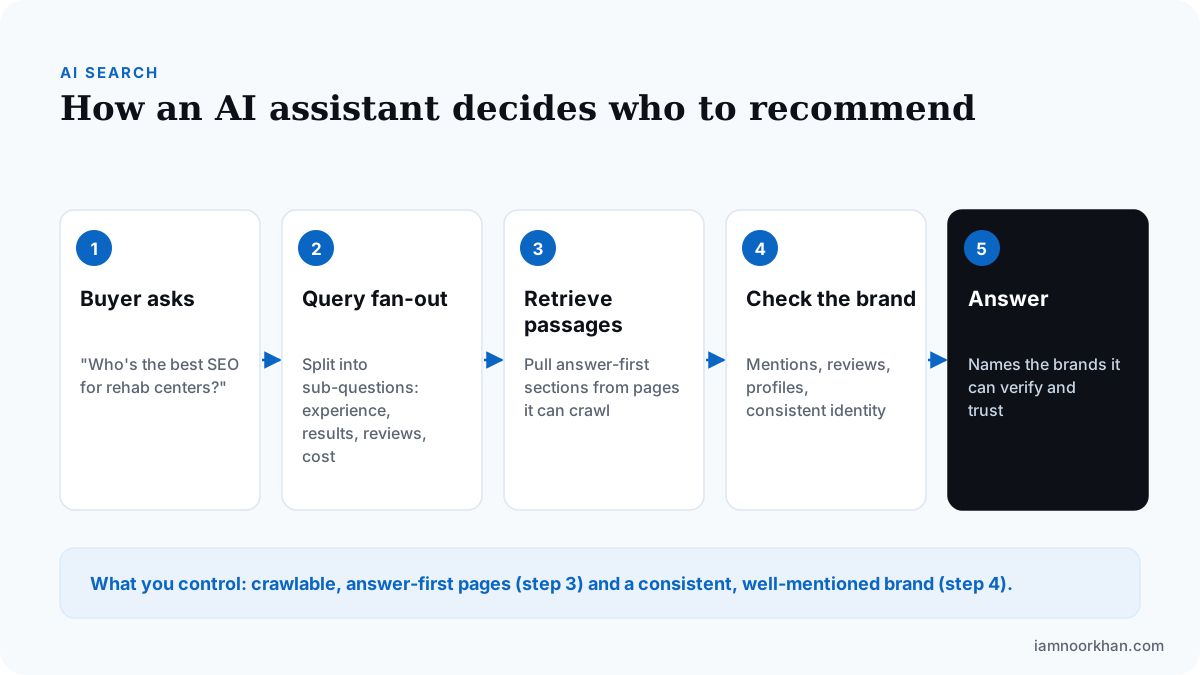
- The question is broken down. "Best physical therapist for a running injury in Austin" becomes sub-questions about specialties, reviews, location and cost. This is called query fan-out.
- Pages are retrieved through OpenAI's own crawler and third-party search providers. OpenAI hasn't published exactly how much each provider contributes, but Bing is widely reported to be one of them (Yoast).
- The clearest passages are pulled out. A paragraph that answers the sub-question directly is easier to use than one buried in a vague page. That's passage retrieval.
- The answer names the businesses that came through clearly and were backed up by other sources: reviews, directories, articles, lists.
One detail surprises most people. BrightEdge's 2025 research reported that ChatGPT mentions brands about 3.2 times more often than it links to them. Being named is often the win, even when there's no click to show for it.
The OpenAI crawler cheat-sheet (and the mistake most guides make)
To appear in ChatGPT search, your site must allow OAI-SearchBot. That's the single most important technical setting, and it's often confused with GPTBot.
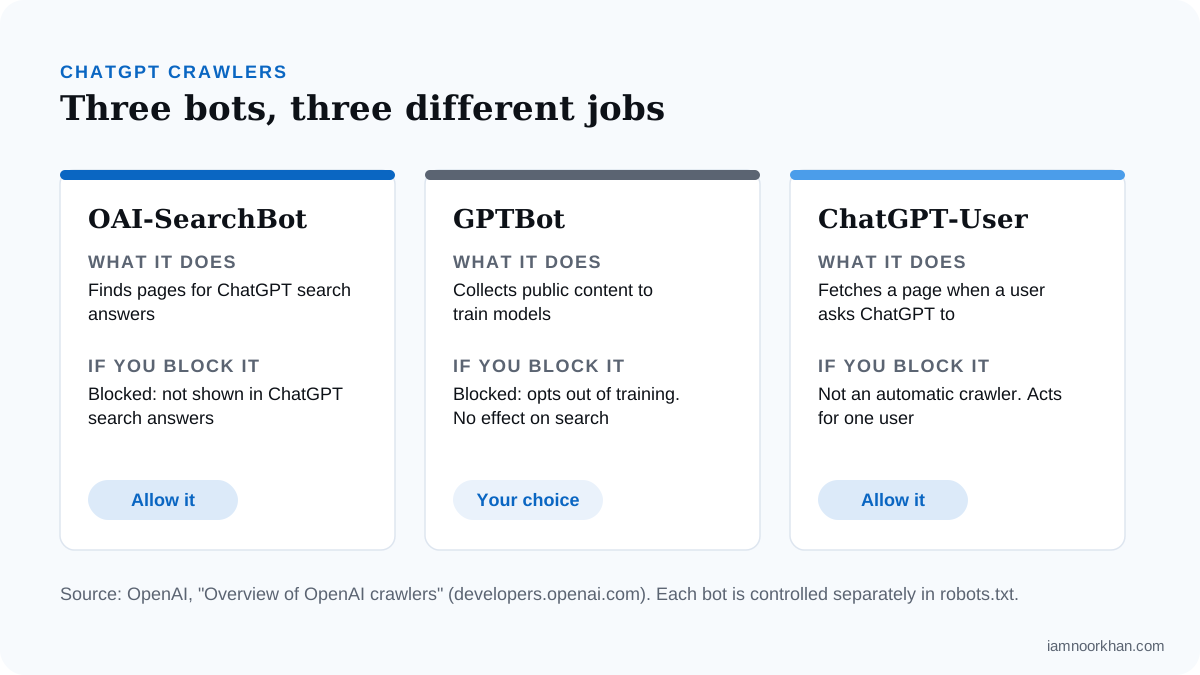
OpenAI runs three separate user agents, and its crawler documentation is clear that each robots.txt setting is independent of the others:
| User agent | What it does | If you block it |
|---|---|---|
| OAI-SearchBot | Finds and surfaces websites in ChatGPT's search features | You won't be shown in ChatGPT search answers (you may still appear as a plain navigational link) |
| GPTBot | Collects public content to train OpenAI's models | You opt out of future training. No effect on search |
| ChatGPT-User | Visits a page when a user's request needs it | Not an automatic crawler; it only fetches pages in response to user actions |
Several popular guides tell you to "allow GPTBot so you can rank in ChatGPT." That mixes up training with search. You can keep your content out of training and still be fully visible in ChatGPT search.
Here's a robots.txt pattern for a business that wants to appear in ChatGPT search but would rather not contribute to training. Adjust it to your own preference:
# Let ChatGPT search find and cite your pages
User-agent: OAI-SearchBot
Allow: /

# Let ChatGPT fetch a page when a user asks about it
User-agent: ChatGPT-User
Allow: /

# Optional: opt out of model training (does not affect search)
User-agent: GPTBot
Disallow: /

# Bing feeds AI answers too, so keep Bingbot welcome
User-agent: Bingbot
Allow: /
Two practical notes. First, robots.txt isn't the only gatekeeper: firewall rules and "block AI bots" toggles in CDNs or security plugins can override it, so check those too. Second, OpenAI says it takes about 24 hours for a robots.txt change to reach its search systems, so you don't need to wait weeks to see whether a fix took. If you'd rather keep a page out of ChatGPT entirely, OpenAI's publisher FAQ notes it can still show a disallowed URL's link and title, and recommends a noindex tag instead.
Bing: the back door into ChatGPT
Because ChatGPT search pulls results from third-party providers, and Bing is reported to be one of them, being well indexed in Bing is one of the cheapest ways to improve your chances. Most businesses I audit have never opened Bing Webmaster Tools.
One analysis makes the point sharply. Seer Interactive looked at more than 500 ChatGPT search citations and found 87% matched Bing's top organic results, compared with 56% for Google. It was a small study from ChatGPT search's early days, so treat it as a strong hint rather than a law. Still, the direction is hard to ignore.
What to do in Bing, in order:
- Verify your site in Bing Webmaster Tools. You can import it straight from Google Search Console.
- Submit your XML sitemap and check for crawl errors on your key service and location pages.
- Turn on IndexNow (many CMSs and SEO plugins support it) so Bing hears about new or updated pages right away instead of waiting for a recrawl.
- Check the AI Performance report. Bing now shows how often your pages are cited in Copilot and Bing's AI answers, along with sample "grounding queries", according to Search Influence's walkthrough of the report. It measures Microsoft's AI answers, not ChatGPT's, but it's the closest first-party citation data you can get today.
For local businesses: AI is now a top-three discovery channel
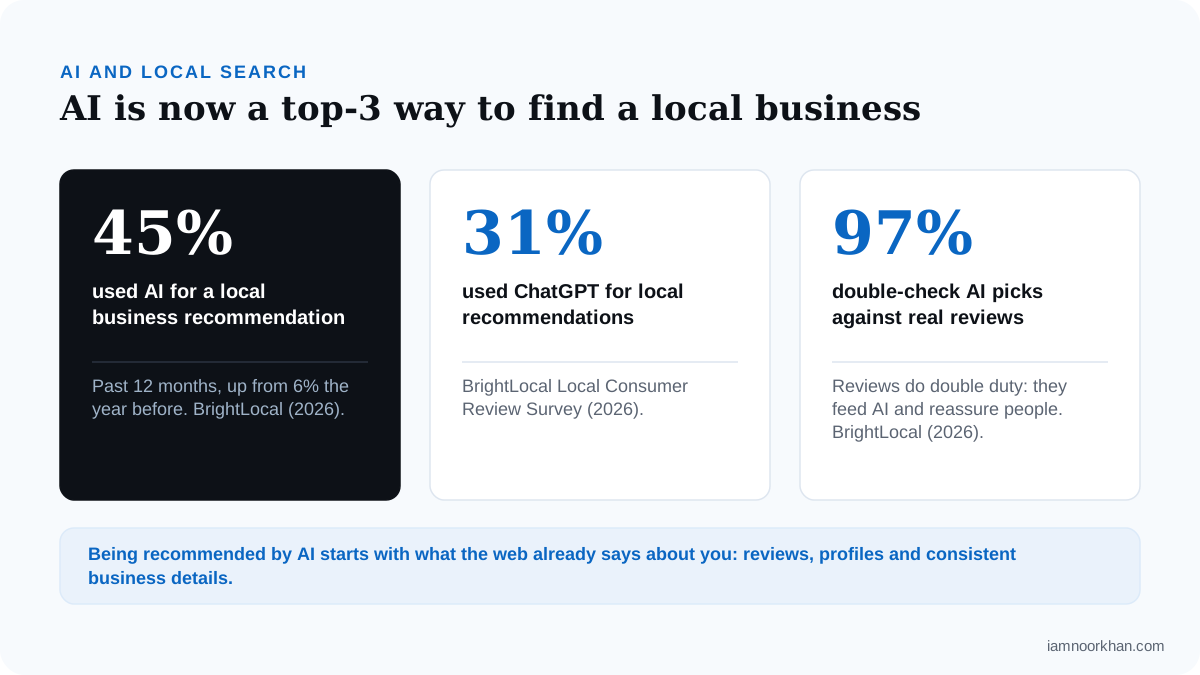
If you run a clinic, a law firm, a restaurant or a trades business, this section matters most. BrightLocal's 2026 Local Consumer Review Survey found that 45% of US consumers used an AI tool to get a local business recommendation in the past 12 months, up from 6% the year before. AI is now the third most used source for local recommendations, behind Google and Facebook.
Two more findings from the same survey shape how I advise local clients:
- 31% of consumers used ChatGPT specifically for a local recommendation.
- 97% of AI users double-check AI recommendations against real reviews, according to BrightLocal's look at AI trust (2026).
That second number means your reviews do double duty. They're part of what an assistant reads when it decides whether to name you, and they're what the customer checks before they call. For local businesses, the work looks like this:
- Keep your business name, address, phone number, hours and categories identical across your website, Google Business Profile, Bing Places, Apple Business Connect and the main directories in your field.
- Give each location and each core service its own page that says plainly what you do, where and for whom.
- Ask happy customers for reviews in a steady rhythm, and reply to them. Reviews that mention the specific service ("they treated my Achilles tendon injury") give an assistant something concrete to repeat.
If you're in healthcare, be extra careful. Patients are making decisions about their health, so accuracy, licensed credentials and honest descriptions of what you treat matter even more. My healthcare SEO work starts there for a reason.
Mentions vs links: what the research says (and what it doesn't)
What other people say about your brand seems to matter more for AI visibility than classic backlinks. The best data we have points that way, with an important caveat.
Ahrefs' 2025 study of 75,000 brands found that branded web mentions had the strongest correlation with visibility (0.664), followed by branded anchor text (0.527) and branded search volume (0.392). Backlinks scored much lower, about 0.22 in the reported figures.
Now the caveat: that study measured Google's AI Overviews, not ChatGPT. And correlation isn't causation. Brands that get mentioned a lot are usually big, well-known brands for many other reasons too. I use it as directional evidence that being talked about matters, not as proof that each mention moves the needle.
It lines up with how ChatGPT's citations look, too. Ahrefs analyzed ChatGPT's 1,000 most-cited pages in 2025 and found 67% came from sources marketers can't easily influence, such as Wikipedia (29.7%), homepages (23.8%) and app store listings (6.6%). Two lessons for business owners:
- Your homepage is a citation asset. It needs to state clearly who you are, what you do and for whom, because it's often the page that gets cited.
- The rest comes from other people's pages: reviews, educational articles, news and blog posts. That's where earned mentions live.
My podcast guest Peter Rota, Senior Technical SEO Manager at HUB International, put the foundation simply: "If you have a basic foundation of SEO, you're going to get 80% of the way there." You can hear the full conversation in what actually changes in AI search.
Expect volatility: there is no "rank #1 in ChatGPT"
There's no fixed ranking in ChatGPT, so stop chasing one. Ask the same question twice and you'll often get a different list.
SparkToro and Gumshoe's 2026 study ran 2,961 prompts across ChatGPT, Claude and Google's AI and found less than a 1-in-100 chance of getting the same list of brands twice. The brands changed, the order changed, and even the number of recommendations changed.
This is freeing, honestly. It means:
- One screenshot of a competitor "ranking first" proves very little.
- Any tool or agency promising a guaranteed position in ChatGPT is promising something nobody can deliver.
- The useful metric is how often you're named across many runs of many relevant questions. I call it your appearance rate.
How to measure whether ChatGPT is recommending you
You measure ChatGPT visibility in two ways: the traffic it sends, and how often it names you when nobody clicks.
1. Track referral traffic in GA4. OpenAI's publisher FAQ confirms that ChatGPT adds utm_source=chatgpt.com to the links it shares. In Google Analytics 4, open Reports → Acquisition → Traffic acquisition, switch the dimension to "Session source", and look for chatgpt.com. Better still, create a custom channel group called "AI assistants" that includes chatgpt.com, perplexity.ai, copilot.microsoft.com and gemini.google.com, so the numbers sit in one line.
2. Run a monthly prompt panel. Write 10–20 questions your buyers actually ask, run each one several times, and record the results in a simple tracker like this one:
| Prompt | Runs | Times we were named | Competitors named | Sources cited | Described accurately? |
|---|---|---|---|---|---|
| "Best physical therapist for runners in Austin" | 5 | 2 | Clinic A (5), Clinic B (3) | Yelp, local news roundup | Yes |
| "Physical therapy for Achilles tendonitis Austin" | 5 | 0 | Clinic A (4) | Clinic A's service page | n/a |
The "sources cited" column is gold. It tells you exactly which directories, roundups and review sites to work on next. My full method, including a scorecard, is in how to measure AI search visibility.
A worked example: the same clinic, before and after
Here's an illustrative example, a made-up physical therapy clinic, showing the kind of changes I'd make. Notice that none of them involve tricks.
| Before | After | |
|---|---|---|
| Homepage headline | "Helping you move better" | "Sports physical therapy for runners and athletes in Austin, TX" |
| Service pages | One "Services" page listing 12 treatments | Separate pages for Achilles, knee and running-injury rehab, each opening with a direct answer |
| robots.txt / CDN | "Block AI bots" toggle on in the CDN | OAI-SearchBot, ChatGPT-User and Bingbot allowed; GPTBot their choice |
| Bing | Never verified | Verified, sitemap submitted, IndexNow on |
| Business details | Three spellings of the clinic name across directories | One name, address and category everywhere, with sameAs links in schema |
| Reviews | 14 Google reviews, last one 8 months ago | A steady monthly ask after discharge, replies to every review |
| Third-party mentions | None | Listed in two local "best PT" roundups the panel showed ChatGPT citing |
In the "before" version, an assistant has almost nothing specific to repeat and may not be able to reach the site at all. The "after" version gives it a clear answer to "who is this, what do they do, and who else vouches for them?"
Your step-by-step action plan
Here's the order I work in, because each step makes the next one count. Answer-first structure (Peter's advice to "get your most important content early, versus burying it in the middle of the page") runs through all of it.
- Benchmark first. Run your prompt panel and note your current appearance rate, competitors and cited sources. Most businesses start at or near zero, and that's fine.
- Open the doors. Allow OAI-SearchBot, ChatGPT-User and Bingbot in robots.txt, and check your CDN or firewall isn't blocking them.
- Get into Bing. Verify in Bing Webmaster Tools, submit your sitemap and turn on IndexNow.
- Say clearly what you do, for whom. Put a one-sentence positioning statement on your homepage and About page, and give every core service its own page that answers its main question in the first sentence. Here's how to structure content for AI answers.
- Make your brand entity consistent. Use the same name, description and categories on every profile, and add Organization or LocalBusiness structured data with
sameAslinks. This is the heart of entity SEO. - Earn reviews and mentions. Build a steady review habit, then pursue the directories, roundups, podcasts and publications your prompt panel shows ChatGPT citing.
- Cover the follow-up questions. Pricing approach, process, timelines, comparisons. A topical map shows which of those pages are missing.
- Measure monthly. Re-run the same panel and check your
chatgpt.comtraffic in GA4. Look for trends over three to six months, not week-to-week swings.
The foundations pay off beyond AI, too. My work with Olympic Behavioral Health grew their organic conversions by 300%. That was Google search, not ChatGPT, but it's the same groundwork AI assistants rely on: clear, crawlable, trustworthy pages.
What doesn't work
Shortcuts tend to backfire, and some can damage the trust you're trying to build.
- Hidden prompts or "summarize with AI" links that try to plant instructions in assistants. Platforms treat this as manipulation.
- Mass-produced pages that say what everyone else says. They add pages without adding information gain.
- Fake reviews or paid list placements. Low-quality sources don't build credibility, and fake reviews can break platform rules and consumer protection laws.
- Anyone guaranteeing AI recommendations. Given how much answers vary, nobody can promise a spot.
Quick checklist
- OAI-SearchBot, ChatGPT-User and Bingbot can reach your important pages (robots.txt and CDN)
- Site verified in Google Search Console and Bing Webmaster Tools, with IndexNow on
- Homepage and About page state who you are, what you do and for whom
- Every core service (and location) has its own answer-first page
- Organization or LocalBusiness schema with
sameAslinks - Identical name, address and description on every profile and directory
- A steady flow of genuine, specific reviews
- Mentions on the sources your prompt panel shows ChatGPT citing
- An "AI assistants" channel in GA4 and a monthly prompt panel
The bottom line
The businesses ChatGPT recommends are, almost always, the ones a well-informed friend would recommend too: clearly positioned, genuinely good at what they do, and talked about by others. Your job is to make that easy for a machine to see. If you want the bigger picture of how this fits with traditional search, my guide to SEO vs AEO vs GEO explains how the three connect.
If you'd like a second pair of eyes, I offer AI search optimization for healthcare, e-commerce and SaaS businesses. You can also ask for a free gap snapshot and I'll show you where ChatGPT currently stands on your business and what I'd fix first.
Frequently asked questions
How does ChatGPT decide which businesses to recommend?
When ChatGPT searches the web, it retrieves pages through its own crawler and third-party search providers such as Bing, then summarizes what those sources say. Businesses that are clearly described on their own site and consistently reviewed and mentioned elsewhere are easier for it to find, verify and name.
Does ChatGPT use Google or Bing?
OpenAI says ChatGPT search uses third-party search providers, and Bing is widely reported to be one of them; OpenAI also runs its own search crawler, OAI-SearchBot. It does not use Google's index directly. That is why verifying your site in Bing Webmaster Tools is worth the 15 minutes it takes.
Should I block GPTBot? Will it stop me appearing in ChatGPT?
Blocking GPTBot only opts your content out of training OpenAI's models. According to OpenAI's crawler documentation, it does not affect ChatGPT search, which is controlled by OAI-SearchBot. If you want to appear in ChatGPT answers, make sure OAI-SearchBot is allowed.
Can I pay to be recommended by ChatGPT?
There is no way to buy a place in ChatGPT's organic answers. Visibility comes from being findable and credible: crawlable pages, clear positioning, genuine reviews and mentions on sources the assistant retrieves.
How do I know if ChatGPT is sending traffic to my website?
ChatGPT adds utm_source=chatgpt.com to the links it shares, so in Google Analytics 4 you can find those visits under the session source chatgpt.com. Pair that with a monthly set of buyer prompts to see whether you are being named, even when people don't click.
Why does ChatGPT give different recommendations each time?
AI answers are generated fresh on every run, so the brands, their order and the number of options all vary. SparkToro's 2026 study found less than a 1-in-100 chance of getting the same brand list twice, which is why visibility should be measured across many runs rather than one screenshot.
How long does it take to show up in ChatGPT?
Technical fixes can help quickly: OpenAI says robots.txt changes reach its search systems in about 24 hours. Building the reviews, mentions and clear positioning that earn recommendations usually takes months of steady work.
Keep reading
 podcast · 14 min
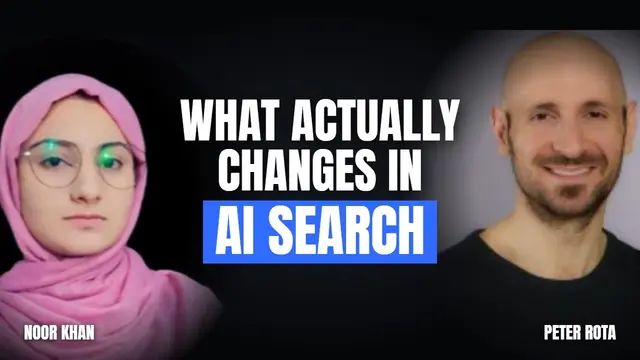
Peter Rota on What Actually Changes in AI Search
Is GEO just SEO with a new name? Peter Rota (HUB International) on falling clicks, structuring content for AI answers and the first 3 moves on a new site.
· with Peter Rota
podcast · 14 min
Peter Rota on What Actually Changes in AI Search
Is GEO just SEO with a new name? Peter Rota (HUB International) on falling clicks, structuring content for AI answers and the first 3 moves on a new site.
· with Peter Rota
 Healthcare SEO
Addiction Treatment SEO: How Rehab Centers Win Admissions from Search
The people searching for treatment are often frightened, exhausted and searching on behalf of someone they love. This guide shows how a rehab center earns their trust in search, honestly and within the rules.
· 12 min read
Healthcare SEO
Addiction Treatment SEO: How Rehab Centers Win Admissions from Search
The people searching for treatment are often frightened, exhausted and searching on behalf of someone they love. This guide shows how a rehab center earns their trust in search, honestly and within the rules.
· 12 min read
 Technical SEO
What Does an SEO Audit Include? (And What to Ignore)
If you've been handed a 200-line audit and still don't know what to fix first, you're not alone. Here's what a useful audit covers, what it can safely skip, and how to tell a real audit from a crawler export.
· 11 min read
Technical SEO
What Does an SEO Audit Include? (And What to Ignore)
If you've been handed a 200-line audit and still don't know what to fix first, you're not alone. Here's what a useful audit covers, what it can safely skip, and how to tell a real audit from a crawler export.
· 11 min read