AI Search · Complete guide
SEO vs AEO vs GEO: What Actually Changes When AI Answers the Query
If every new acronym leaves you wondering whether your SEO budget was wasted, it wasn't. Here is what stays the same, what genuinely changes when AI answers the query, and where to put your effort first.
 By Noor Khan
Key takeaways
- SEO earns rankings, AEO earns the direct answer, GEO earns a mention or citation inside an AI-generated response. All three run on the same foundation.
- GEO comes from a 2023 research paper that found certain content edits raised visibility in AI answers by up to 40%, mostly by adding statistics, quotations and cited sources.
- Google's position is clear: there are no special optimizations needed for AI Overviews or AI Mode, and optimizing for generative AI search is still SEO.
- What does change is the outcome: Pew found users clicked a result on 8% of visits with an AI summary, against 15% without one.
- Measure visibility and citations alongside clicks, keep conversions as the goal, and be wary of anyone selling urgency and new acronyms.
Every few months the industry invents a new acronym and a new reason to panic. Right now it's AEO and GEO, and if you run a business, you've probably been told your SEO is outdated and you need to "optimize for AI" before it's too late.
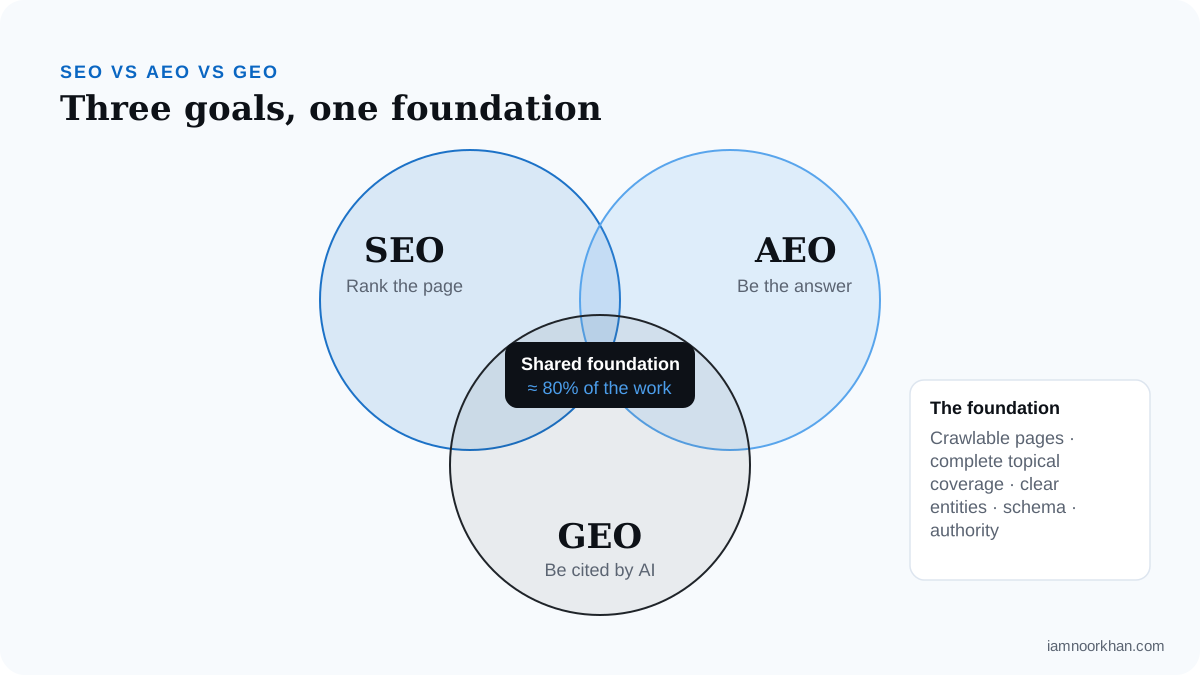
I want to take some of that pressure off. When I asked Peter Rota on my podcast what actually changes in AI search, he said: "If you have a basic foundation of SEO, you're going to get 80% of the way there." That matches what I see in client work, and as you'll see below, it matches what Google itself says.
But "it's all just SEO" isn't the full picture either. Something real does change when an AI writes the answer instead of listing ten links. This guide covers what each term means, where the word GEO came from, what the data says about clicks, and where I'd put your effort first.
SEO vs AEO vs GEO at a glance
SEO earns a ranking in search results, AEO earns the direct answer, and GEO earns a mention or citation inside an AI-generated response. They are three goals built on one foundation, not three separate disciplines.
| SEO | AEO | GEO | |
|---|---|---|---|
| Target | Google and Bing results | Featured snippets, voice assistants, AI Overviews | ChatGPT, Perplexity, Gemini, Copilot, AI Overviews and AI Mode |
| Output | A ranked link to your page | Your passage shown as the answer | Your brand mentioned, cited or recommended in a generated answer |
| Success metric | Rankings, clicks, conversions | Answer ownership, impressions | Mentions, citations, AI referrals, conversions |
| Main tactics | Relevance, topical authority, links, technical health | Answer-first formatting, question coverage, structured data | Everything in SEO and AEO, plus brand consistency and third-party mentions |
| Measurement | Search Console, rank tracking, analytics | Search Console impressions, SERP feature tracking | Prompt checks across AI assistants, AI referral traffic, brand mention tracking |
Notice how much the columns overlap. That overlap is Peter's 80%.
AI search by the numbers
AI answers now sit in front of a very large share of searches, and they change how often people click. A few figures help put the shift in proportion:
| What | Figure | Source |
|---|---|---|
| Google AI Overviews users | 2 billion+ a month, in 200+ countries and territories (July 2025) | TechCrunch, 2025 |
| ChatGPT users | 800 million+ a week (October 2025) | TechCrunch, 2025 |
| Google searches | 5 trillion+ a year (2025) | Search Engine Land, 2025 |
| Clicks with an AI summary | 8% of visits, vs 15% without one | Pew Research Center, 2025 |
| Zero-click searches (US) | 58.5% of Google searches (2024) | SparkToro via Search Engine Land, 2024 |
Two things are true at once here. AI assistants are huge, and Google is still where most searching happens. Both matter for where you spend your time.
What is SEO?
SEO (search engine optimization) is making your pages easy for search engines to find, understand and trust, so they rank for the searches your customers make. It covers technical health, content that matches search intent, internal links and the authority your site earns from others.
None of that has gone away. AI systems that search the web before answering, including Google's own AI features, still need a page to be crawlable, indexed and relevant before they can use it.
What is AEO?
Answer engine optimization is structuring content so a search engine or assistant can lift your passage and present it as the direct answer. The term predates generative AI: it grew up around featured snippets and voice assistants, which also read out one answer instead of a list.
AEO is mostly page-level work: headings phrased as real questions, a short direct answer under each one, and lists and tables where they help.
What is GEO, and where did the term come from?
Generative engine optimization is making your content and brand more likely to be cited or recommended inside answers that an AI writes by combining several sources. The term was coined in a research paper, "GEO: Generative Engine Optimization", by Pranjal Aggarwal and colleagues, first posted to arXiv in November 2023 and published at the KDD 2024 conference.
That paper is where the much-quoted "up to 40%" figure comes from, and it's worth understanding what it does and doesn't say.
What the GEO paper's 40% really means
The researchers found that certain edits to a page's content could raise its visibility in generative engine responses by up to 40%. They built a benchmark of queries (GEO-bench), tested nine optimization methods, and measured how visible each source was in the AI-generated answers.
Here is what I take from it as a practitioner:
- "Up to" is doing a lot of work. 40% was the top result, not the typical one, and the paper notes that what works varies by domain.
- It measured visibility inside the answer, not traffic or sales. Being cited more often is useful, but it's a different outcome from a click or a lead.
- The winning methods were editorial quality, not tricks. Among the methods tested were adding statistics, adding quotations and citing sources. Those are the habits of careful, trustworthy writing.
- It was a controlled research setup. Real assistants change constantly, so treat the findings as direction, not a formula.
In other words, the paper that named GEO mostly rewards the same thing good SEO content already does: specific facts, credible sources and clear expert language.
What Google says about AEO and GEO
Google's position is that optimizing for its AI features is SEO. Its documentation page, AI features and your website, says: "There are no additional requirements to appear in AI Overviews or AI Mode, nor other special optimizations necessary." To be shown as a supporting link, a page only needs to be indexed and eligible to appear in Search with a snippet.
In May 2026 Google went further and published a full guide, Optimizing your website for generative AI features on Google Search. As Search Engine Journal reported in 2026, the guide states: "From Google Search's perspective, optimizing for generative AI search is optimizing for the search experience, and thus still SEO." The same coverage notes the guide treats llms.txt, content chunking, rewriting content for AI and special schema as unnecessary for Google's generative features. Its strongest advice is to publish unique, non-commodity content people find genuinely useful.
Google's people have said the same thing out loud:
- Danny Sullivan, at his WordCamp US keynote in August 2025, showed a slide reading "Good SEO is good 'GEO'" (Search Engine Land, 2025).
- John Mueller put it practically: "What you call it doesn't matter, but 'AI' is not going away." He advised businesses to "be realistic and look at actual usage metrics and understand your audience" (Search Engine Land).
One honest caveat: this is Google speaking about Google. ChatGPT, Perplexity and other assistants have their own retrieval systems and sources. The fundamentals overlap heavily, but your brand's presence beyond your own site matters more for them, which is the part of GEO that genuinely adds work.
What stays the same
The foundations of SEO carry straight over into AI search, because retrieval-based AI systems search an index, pull relevant passages and then write an answer from them. To be in that answer, you first have to be findable and trusted.
- Crawl access for every bot that matters. Google, Bing and AI crawlers (GPTBot, OAI-SearchBot, PerplexityBot, ClaudeBot) need to reach your pages. It's worth checking that robots.txt rules or firewall settings aren't blocking them by accident.
- Topical authority. A site that covers a subject completely, with pages that reinforce each other, is the one systems trust to answer questions in that space. A topical map is how you plan that coverage.
- Structured data. JSON-LD states what a page is, who wrote it and what it's about, so machines don't have to guess.
- Helpful, people-first content. Google's guidance hasn't changed: content written for people, by someone who knows the subject, is what its systems are designed to reward.
What genuinely changes
Three things shift when an AI writes the answer instead of listing ten links: the unit that wins, the role of your brand, and what success looks like.
1. The passage is the unit, not the page
AI systems pull individual passages, a process often called passage retrieval. An article with its key answer buried in paragraph nine is easy to skip. Peter's advice on the podcast was simple: "Get your most important content early, versus burying it in the middle of the page like people were doing five years ago." I've written a full guide on how to structure content for AI answers.
2. Your brand's reputation becomes part of the answer
When an assistant recommends a provider, it draws on what the wider web says about you, not only on your own pages. Consistent positioning across your site, LinkedIn, directories, reviews and press starts to matter in a way it never did for a blue link. My guide on how to get recommended by ChatGPT walks through this step by step.
3. Clicks become a weaker signal of success
More searches end without a click, so traffic alone undercounts your visibility. The data on this is consistent across very different methods:
- Pew Research Center's 2025 study of 900 US adults' browsing found users clicked a result on 15% of visits without an AI summary and 8% with one. They clicked a link inside the summary on just 1% of visits.
- Ahrefs' 2025 study of 300,000 keywords found an AI Overview correlated with a 34.5% lower average click-through rate for the top-ranking page, comparing March 2024 with March 2025.
- SparkToro and Datos' 2024 zero-click study found 58.5% of US Google searches (and 59.7% in the EU) ended without a click, before AI Overviews were widespread.
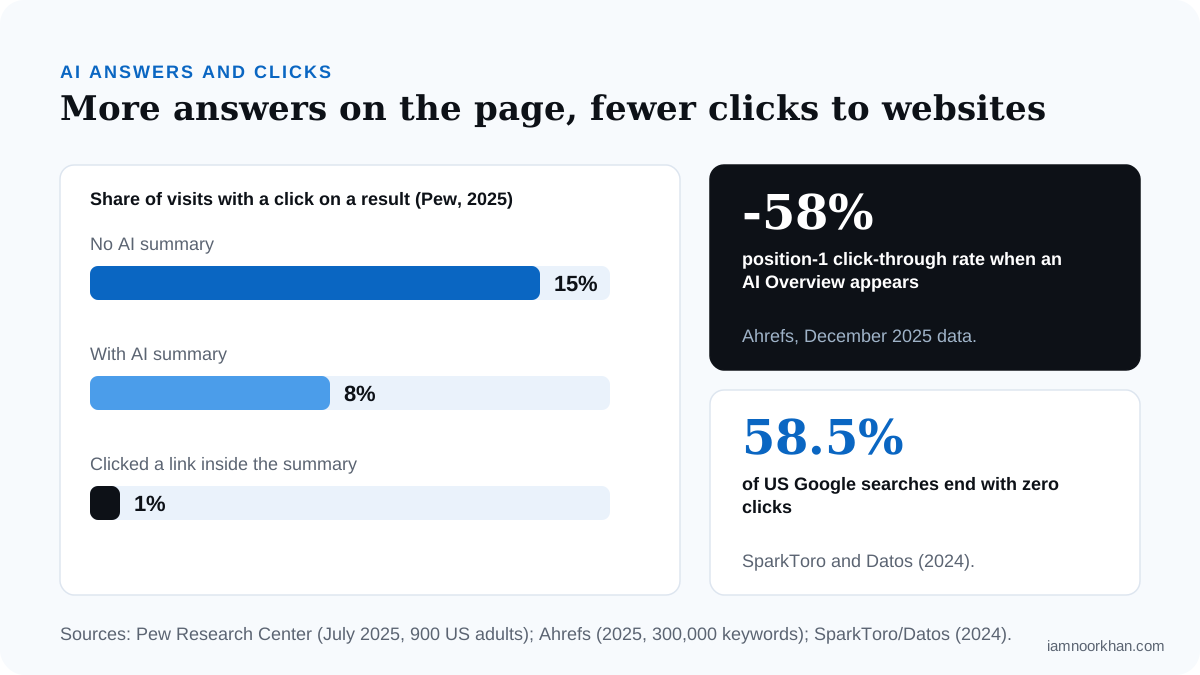
These are correlations across many searches, not a forecast for your site. Peter described the same pattern on the podcast: his team's glossary content lost clicks but gained impressions, so they now report impressions as visibility next to clicks, and keep conversions as the number that matters. That's why zero-click search changes how you report, not whether SEO is worth doing.
Was Gartner right that search would drop 25% by 2026?
Not in any way the public numbers show so far. In February 2024, Gartner predicted that traditional search engine volume would drop 25% by 2026 as people turned to AI chatbots and virtual agents.
Here's how that looks from 2026:
- Google's volume grew, by its own account. Google said in 2025 that it sees more than 5 trillion searches a year, its first disclosure since it reported "more than 2 trillion" in 2016 (Search Engine Land, 2025).
- Google says AI features add searches. In July 2025, Google said AI Overviews were driving over 10% more queries for the types of searches that show them (TechCrunch, 2025).
- Google's share held around 90%. StatCounter's figures have reportedly kept Google at roughly 90% of worldwide search through 2026.
- But chatbots grew enormously too. ChatGPT went from 500 million weekly users in March 2025 to more than 800 million by October 2025, and was reported at 900 million in February 2026 (TechCrunch, 2026).
So Gartner was right about the direction (people really do ask AI assistants questions they used to search for) and, on the evidence available, wrong about the size of the drop. The bigger change wasn't fewer searches. It was AI answers appearing inside search, which is why clicks fell even as searches grew. Google's own figures come from Google, of course, so treat them as its account rather than independent measurement.
A worked example: one passage, before and after
The quickest way to see AEO and GEO in practice is to rewrite a single passage. Imagine a SaaS company's integrations page, and a buyer asking an assistant, "Does [Product] integrate with HubSpot?"
Before (typical marketing copy):
We believe your tools should work together seamlessly. That's why our team has spent years building a powerful ecosystem of integrations with the platforms you already love, so you can focus on what matters most: growing your business.
After (answer-first, specific, extractable):
Yes. [Product] integrates natively with HubSpot. The integration syncs contacts, companies and deal stages in both directions every 15 minutes, and it's included on all paid plans. Setup takes about ten minutes from Settings → Integrations, with no developer needed.
The "after" version answers the question in its first word, names the entity (HubSpot) explicitly, and gives concrete details an assistant can quote accurately. Notice it's also simply better for the human reader. (The specifics here are illustrative; on your own page, every detail must be true.)
This is the pattern I apply across a client's most important pages before writing anything new. It's part of the same approach behind my client results, such as Grove Healthcare's 250% growth in organic traffic and Olympic Behavioral Health's 300% increase in organic conversions: clear, complete, well-structured pages that both people and machines can trust.
AEO and GEO in practice: two short checklists
AEO work happens on the page; GEO work extends across your whole brand. Most sites need both, in that order.
AEO checklist (each important page):
- Headings phrased as the questions people actually ask.
- A direct one-to-two sentence answer immediately under each heading.
- Numbered lists for steps, tables for comparisons.
- Author, date and sources visible, especially on health and money topics.
- An FAQ section only where it answers genuine questions, marked up with FAQPage schema.
GEO checklist (your whole brand):
- AI crawlers can reach your important pages.
- Your positioning is stated plainly on the homepage, About page and service pages.
- Your name, description and specialty are consistent across every profile.
- You're mentioned on credible third-party sites: reviews, directories, podcasts, articles.
- You check monthly what ChatGPT, Perplexity, Gemini and AI Overviews say about you. Here's how to measure AI search visibility with a simple scorecard.
Red flags when hiring an AEO or GEO agency
The more urgency and new jargon someone sells you, the more careful you should be. John Mueller said it bluntly in August 2025: "The higher the urgency, and the stronger the push of new acronyms, the more likely they're just making spam and scamming" (PPC Land, 2025).
Be wary if a provider:
- Guarantees AI citations or rankings. No one controls what ChatGPT or Google's AI says. Guarantees are a sales tactic.
- Says your SEO is "dead" or wasted. Google says the opposite, in writing.
- Sells llms.txt files, AI-only content or special schema as the core fix. Google's 2026 guide reportedly says these aren't needed for its AI features.
- Proposes hidden text, prompt injection or mass-produced pages. These are manipulation tactics and can be treated as spam.
- Can't explain how they'll measure success beyond screenshots of a single prompt. AI answers vary between runs; good reporting tracks a set of questions over time.
- Treats GEO as separate from your existing SEO. If they can't explain how the two connect, they don't understand either well enough.
A good partner should be able to tell you, in plain English, which parts of your foundation are holding you back and what they'd fix first.
Where to put your effort first
Start with the foundation, then widen the lens. This is the order I work in with clients:
- Fix the foundation. Technical health, crawl access for AI bots, schema and internal links. Without these, nothing else lands.
- Map and complete the topic. Build the topical map, then fill the gaps, starting with the questions closest to revenue.
- Restructure for extraction. Put answers first on your most important existing pages before writing new ones.
- Build presence beyond your site. Profiles, mentions, partnerships and podcast appearances. AI assistants draw on what others say about you.
- Measure and adjust. Track impressions, AI mentions and conversions monthly, and keep doing what works.
The short version
SEO, AEO and GEO aren't three jobs. They're one job seen from three angles: be findable, be the clearest answer, and be the brand others vouch for. Google says optimizing for its AI features is still SEO, the research behind GEO rewards specific, well-sourced content, and the real change is that success now shows up as visibility and trust as much as clicks.
If you've invested in SEO and now feel unsure whether it still counts, it does. You probably just need to extend it, not start over. That's exactly what my AI search optimization work covers. And if you'd like to know where your site stands first, ask for a free gap snapshot on the contact page.
Frequently asked questions
What is GEO (generative engine optimization)?
GEO is the practice of making your content and brand more likely to be mentioned, cited or recommended inside answers generated by AI systems such as ChatGPT, Perplexity, Gemini and Google's AI Overviews. The term comes from a 2023 research paper by Aggarwal and colleagues, later published at the KDD 2024 conference. In practice, most GEO work is strong SEO plus attention to how your brand is described across the web.
What is the difference between AEO and GEO?
AEO (answer engine optimization) aims to make a page the direct answer in features like featured snippets, voice assistants and AI Overviews. GEO aims to get your brand mentioned or cited in answers that an AI writes by combining several sources. AEO is mostly about how each page is structured; GEO adds how your whole brand is represented, on and off your site.
Is GEO replacing SEO?
No. AI search systems retrieve from the same indexed web that SEO has always optimized for, and Google says its generative AI features are rooted in its core Search ranking and quality systems. A strong SEO foundation covers most of what GEO needs. GEO adds work on brand consistency and third-party mentions on top.
Does Google say you need GEO or AEO?
No. Google's documentation says there are no additional requirements or special optimizations needed to appear in AI Overviews or AI Mode. Its May 2026 guide, as reported by Search Engine Journal, describes optimizing for generative AI search as still SEO.
Do AI Overviews reduce website traffic?
The evidence says clicks usually fall when an AI summary appears. Pew Research Center found users clicked a result on 8% of visits with an AI summary versus 15% without, and Ahrefs measured a 34.5% lower click-through rate for the top result on keywords with an AI Overview. These are correlations across many searches, so your own pages may be affected more or less.
How do you measure GEO success?
Track impressions and rankings in Google Search Console, check monthly how AI assistants describe and cite your brand for your most valuable questions, and watch referral traffic from AI platforms in your analytics. Keep conversions and qualified leads as the number that matters, because visibility without business results is not the goal.
Keep reading
 podcast · 14 min
Peter Rota on What Actually Changes in AI Search
Is GEO just SEO with a new name? Peter Rota (HUB International) on falling clicks, structuring content for AI answers and the first 3 moves on a new site.
· with Peter Rota
podcast · 14 min
Peter Rota on What Actually Changes in AI Search
Is GEO just SEO with a new name? Peter Rota (HUB International) on falling clicks, structuring content for AI answers and the first 3 moves on a new site.
· with Peter Rota
 AI Search
How to Get Your Business Recommended by ChatGPT and AI Assistants
If you've watched competitors get named by ChatGPT while your business doesn't come up, you're not doing anything wrong. You just can't see how these answers get put together yet. This guide shows you how they work and what you can actually control.
· 12 min read
AI Search
How to Get Your Business Recommended by ChatGPT and AI Assistants
If you've watched competitors get named by ChatGPT while your business doesn't come up, you're not doing anything wrong. You just can't see how these answers get put together yet. This guide shows you how they work and what you can actually control.
· 12 min read
 Healthcare SEO
Addiction Treatment SEO: How Rehab Centers Win Admissions from Search
The people searching for treatment are often frightened, exhausted and searching on behalf of someone they love. This guide shows how a rehab center earns their trust in search, honestly and within the rules.
· 12 min read
Healthcare SEO
Addiction Treatment SEO: How Rehab Centers Win Admissions from Search
The people searching for treatment are often frightened, exhausted and searching on behalf of someone they love. This guide shows how a rehab center earns their trust in search, honestly and within the rules.
· 12 min read