AI Search · Complete guide
AI Search Optimization: The Practical Guide to Getting Found, Cited and Recommended (2026)
How AI search tools choose their sources, what the research and Google's own guidance say actually works, and a 30-day plan, free checklist and audit prompt to get your brand found, cited and recommended.
 By Noor Khan
Key takeaways
- AI search tools retrieve first and write second. If your pages can't be found for the question, or for the related searches it fans out into, nothing else matters.
- Google says its AI features run on its core ranking systems and need no special files or markup. Strong SEO is still the entry ticket; it just isn't the whole game anymore.
- Research points the same way: specific, well-sourced, quotable content is chosen more often, and brands that are widely mentioned elsewhere show up more in AI answers.
- Work on five pillars: Access, Clarity, Substance, Trust and Corroboration. Each answers a question an AI system asks before it cites you.
- Measure monthly with free tools, and use the 30-day plan, readiness checklist and audit prompt in this guide to start this week.
Search didn't disappear. It got a new front door.
People still type into Google, but the answer increasingly arrives as a paragraph at the top of the page. They ask ChatGPT who to hire. They let Perplexity read twenty pages for them and summarize the result. And in each of those answers, only a handful of sources get named.
The numbers are hard to ignore. In a 2025 study of real browsing behavior, Pew Research Center found that people clicked a traditional search result on 8% of visits when Google showed an AI summary, compared with 15% when it didn't. Ahrefs' updated analysis of 300,000 keywords found that the top-ranking page's click-through rate was 58% lower when an AI Overview appeared. And well before AI Overviews were everywhere, SparkToro's 2024 zero-click study found that close to 60% of Google searches in the US and EU ended without a click to any website.
That sounds like bad news, and for some kinds of content it is. But it hides the opportunity: the sources AI tools do choose get seen by everyone who asks, often before a single click happens. Being one of those sources is now one of the most valuable positions in marketing.
This guide is the complete, practical picture: how these systems choose sources, what the evidence says works, what Google itself has said, and exactly what to do about it, with a 30-day plan, a readiness checklist and an audit prompt you can use today.
What AI search optimization actually means
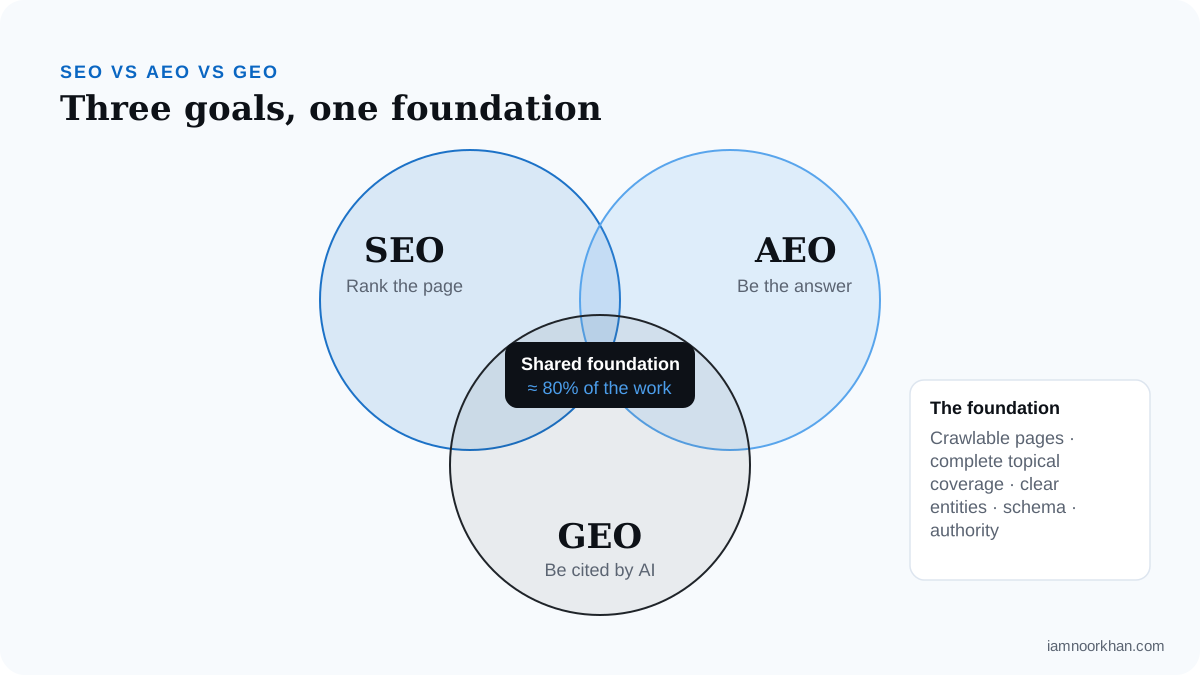
AI search optimization is the work of making your content and brand easy for AI-powered search tools to find, understand, trust and cite. You'll hear it called GEO (generative engine optimization), AEO (answer engine optimization), LLM SEO or AI SEO. The labels differ; the work overlaps almost completely, as I explain in SEO vs AEO vs GEO.
It's useful to separate four kinds of AI visibility, because they're won in different ways:
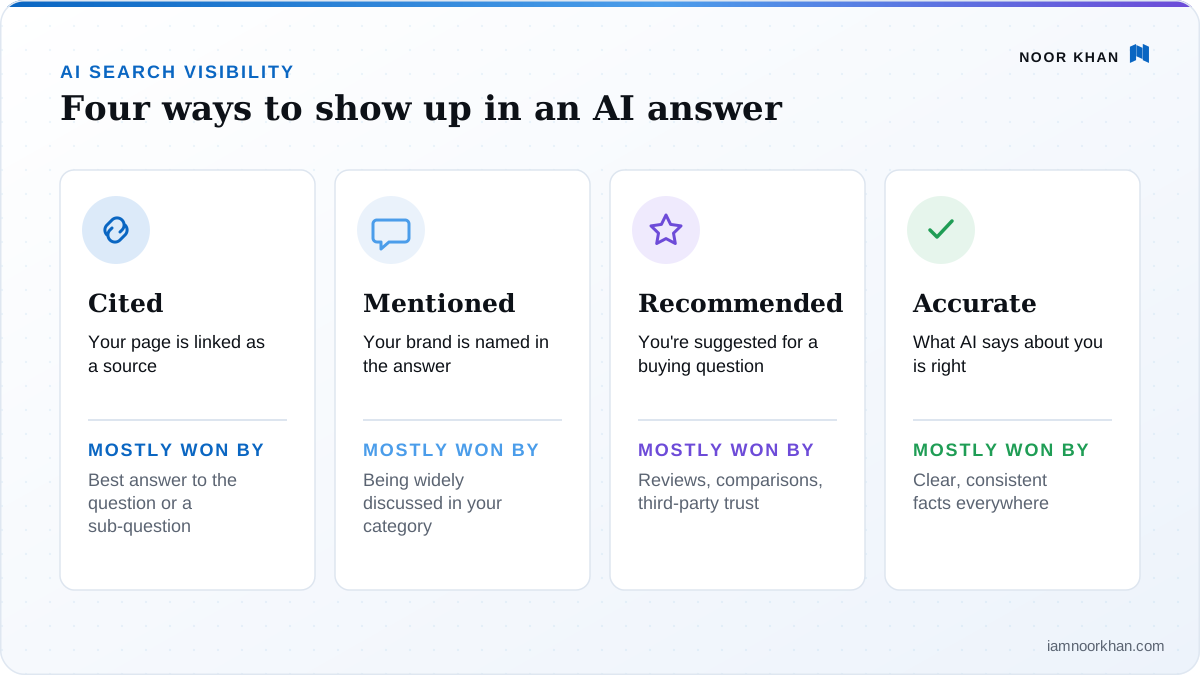
| Visibility | What it looks like | Mostly won by |
|---|---|---|
| Cited | Your page is linked as a source | Pages that answer the question (or a sub-question) best |
| Mentioned | Your brand is named in the answer | Being widely discussed in your category |
| Recommended | You're suggested for a buying question | Reviews, comparisons and third-party corroboration |
| Accurately described | What the AI says about you is right | Clear, consistent facts on your site and profiles |
Most "GEO" advice focuses on the first row. For a business, the last three are often worth more. Someone who reads "for a small team, X is the simplest option" in ChatGPT may never click a link, and still become your customer.
How AI search tools choose their sources
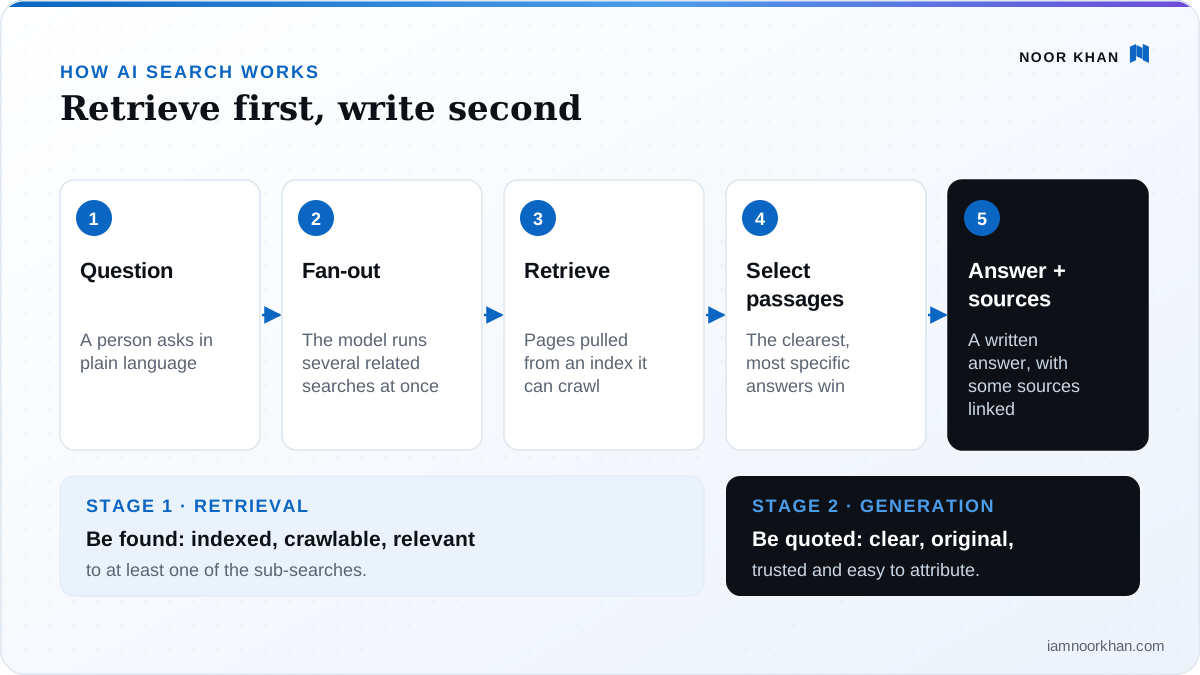
Every major AI search product works in roughly the same two stages: retrieve, then generate. Understanding this one idea will save you from most bad advice.
Stage 1: Retrieval (getting into the shortlist)
When someone asks a question, the system usually searches before it answers. Google describes query fan-out in AI Mode as a set of related queries the model generates at the same time to gather more results. A question like "best project management tool for a remote agency" becomes sub-searches about pricing, integrations, team size, reviews and alternatives.
Mike King of iPullRank, whose agency has published some of the most detailed analysis of AI Mode, describes this as a raffle-ticket model: every sub-query you can satisfy is another ticket in the draw. It also explains something that confused SEOs for months, namely why pages that don't rank for the original query still get cited. They ranked for one of the hidden sub-queries.
Each sub-search pulls from an index:
- Google AI Overviews and AI Mode use Google's own index and ranking systems.
- ChatGPT search uses OpenAI's crawler (OAI-SearchBot) alongside third-party search providers.
- Microsoft Copilot uses Bing's index.
- Perplexity and Claude use their own crawlers plus search providers.
If your page isn't indexed, crawlable and relevant to at least one sub-search, nothing else matters. This is why SEO hasn't died. It has become the entry ticket.
Stage 2: Generation (getting quoted)
From everything retrieved, the model selects the passages that answer each part of the question most clearly, writes a response and attributes some of it to sources. Aleyda Solis puts the practical consequence well in her AI search content optimization checklist: AI systems work with passages, not whole pages, so each section needs to make sense on its own.
Being retrieved isn't the same as being chosen. What tends to get chosen:
- A direct answer in plain language, right next to the question it answers.
- Specific, checkable details: numbers, steps, names, conditions, dates.
- Something the other sources don't have: data, experience, a clear recommendation.
- A source that looks trustworthy for the topic, backed up by what the rest of the web says.
What the research says actually works
There's a lot of confident GEO advice with little evidence behind it. Here's what the better research shows, and its limits.
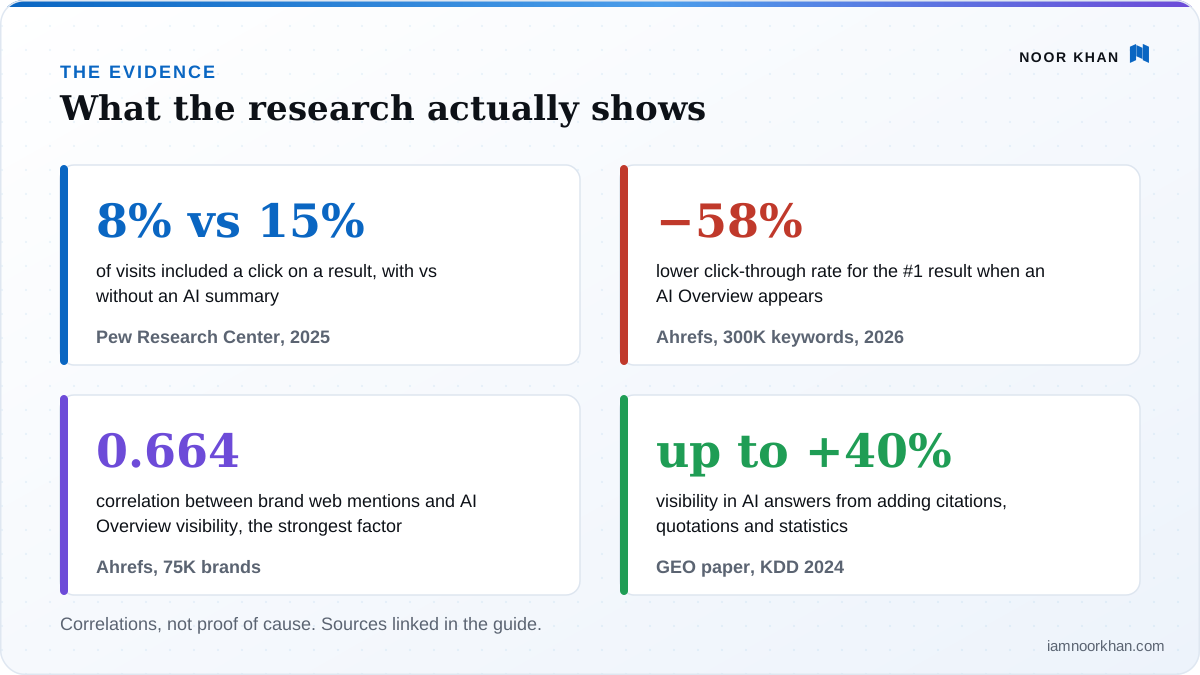
Specific, well-sourced content gets chosen more. The paper that coined the term, GEO: Generative Engine Optimization (Aggarwal et al., presented at KDD 2024), tested content changes against generative engines. Adding things like citations, quotations and statistics improved a source's visibility in AI answers by up to 40% in their experiments, while old-school keyword stuffing didn't help. The effect varied by topic, and "up to" means best case, but the direction is clear: make content more verifiable, not more repetitive.
Being talked about matters more than being linked to. Ahrefs studied 75,000 brands and found that the factor most correlated with appearing in AI Overviews was branded web mentions (a correlation of 0.664), ahead of link-based metrics. It's a correlation, not proof of cause, but it matches how recommendation questions work: AI tools repeat what many credible sources say.
You don't have to be in the top ten. Analyses compiled by iPullRank suggest a large share of AI citations come from pages outside the traditional top ten results for the original query. That's the fan-out effect again, and it's good news for smaller, more specialized sites.
Visibility without clicks still counts. On my podcast, Peter Rota made a point worth remembering when you look at falling click-through rates:
"Just because someone sees you and doesn't click, at a later date they could come back." Peter Rota, Noor Khan Podcast
What Google itself says (read this before buying any "GEO tool")
Google published a dedicated guide to optimizing for its generative AI features in 2026. It's unusually direct, and it settles several arguments:
- There are no special requirements. A page must be indexed and eligible to show with a snippet. No special schema, no AI file.
- llms.txt does nothing for Google Search, positively or negatively.
- No need to chop content into tiny chunks or write in a special way for AI.
- Create "non-commodity" content: unique, expert-led content that goes beyond common knowledge. In Google's words: "Create the content yourself based on what you know about the topic."
- Don't mass-produce pages for every query variation (it can violate the scaled content abuse policy) or chase inauthentic mentions.
- Be skeptical of tools that claim inside knowledge. Google is blunt about it:
"No third-party tool has access to our internal ranking or AI systems." Google Search Central
There's also a new control. In Search Console under Settings → Search generative AI, sites are included in AI Overviews and AI Mode by default, and Google says the setting doesn't affect regular ranking. If your site ever vanishes from AI features, check that first.
My read: Google is telling you that the shortcut industry is mostly selling noise. The work that wins is the work that always won, aimed more precisely at how answers are now assembled.
The five pillars of AI search visibility
Here is the framework I recommend. Each pillar answers one question an AI system is implicitly asking before it cites you. For each, you'll find how to check it and how to fix it.
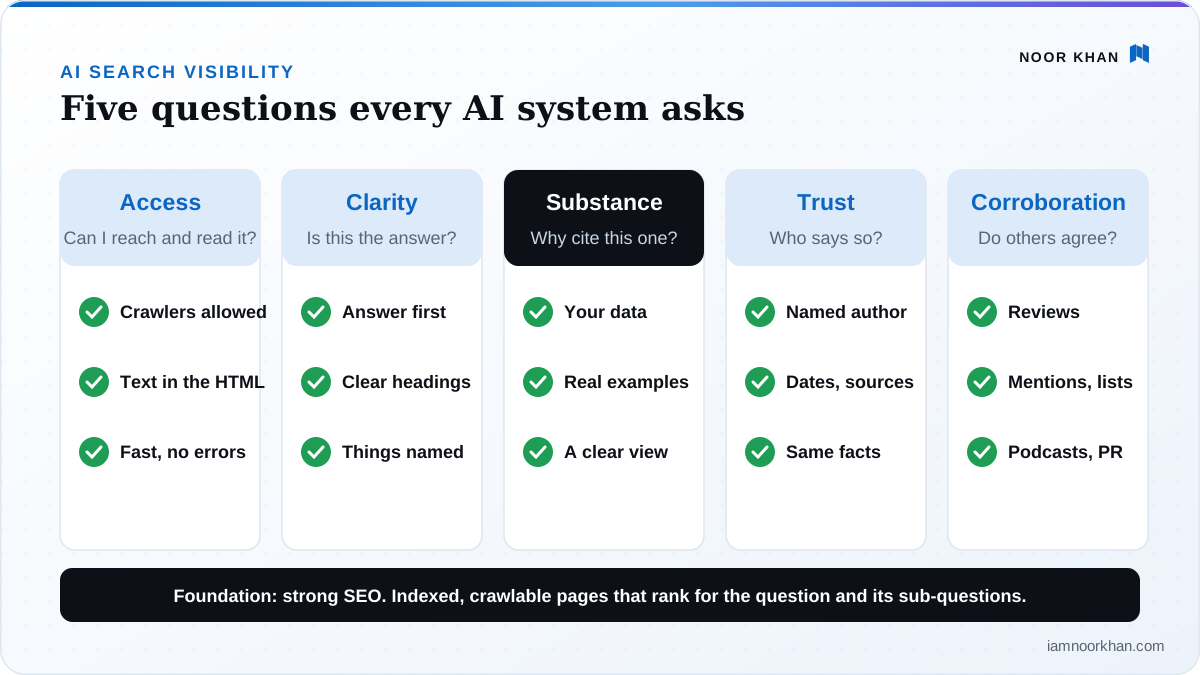
1. Access: "Can I reach and read this page?"
How to check:
- Open
yourdomain.com/robots.txtand look for rules that block OAI-SearchBot, PerplexityBot, Claude-SearchBot, Bingbot or Googlebot. - Check your CDN and security settings. Since July 2025, Cloudflare has blocked known AI crawlers by default for new domains unless the owner allows them.
- Ask ChatGPT (with search on) to "summarize the page at [URL]". If it can't, something is blocking it.
- Use URL Inspection in Google Search Console on your key pages.
How to fix: allow the search crawlers you want (copy-paste rules are in AI crawlers and robots.txt), make sure important content is in the HTML as real text rather than only in images or late-loading scripts, and submit your sitemap to both Google Search Console and Bing Webmaster Tools.
2. Clarity: "What exactly is this, and is it the answer?"
How to check: read only the first sentence under each heading on your most important page. Does each one answer its heading on its own? Could someone repeat it accurately without the rest of the page?
How to fix:
- Lead with the answer. Then add the nuance, evidence and detail. The full method is in how to structure content for AI search.
- Use headings that match how people ask: "How much does a website redesign cost?", not "Our investment philosophy".
- Name things explicitly. Write "Shopify's checkout extensibility", not "it". Passages are read out of context, and pronouns lose their meaning.
- Use tables for comparisons and numbered lists for processes. Both are easy for people and machines to read.
A quick before-and-after:
Before: "There are a lot of factors to consider, and every business is different, so it's worth thinking carefully about your options."
After: "Most small businesses should budget $3,000–$10,000 for a website redesign; the main cost drivers are the number of custom page templates, integrations and who writes the content."
The second version can be quoted. The first can only be skipped.
3. Substance: "Why should I cite this source rather than another?"
This is the pillar most content fails. If your article says what the top ten results already say, an AI has no reason to choose you: it can write that answer without you. What earns the citation is information gain:
- Your own numbers: results, benchmarks, survey data, time and cost figures from real work.
- First-hand experience: what you tried, what happened, what you'd do differently.
- A clear position: "I'd skip X for most small businesses, because…", including when not to do something.
- Useful assets: templates, calculators, checklists, worked examples.
- Sources: link to the studies and official documentation behind your claims. The GEO research suggests verifiable content is preferred.
4. Trust: "Can I rely on whoever wrote this?"
How to check: could a stranger tell, within ten seconds, who wrote the page, why they're qualified and when it was last updated?
How to fix:
- Show a named author with real credentials, linked to an author or About page. This is E-E-A-T in practice.
- Keep facts consistent across your site: one business name, one description, the same prices and claims everywhere.
- Add structured data (Organization or Person, Article, FAQ where genuine) that matches the visible page. It isn't an AI requirement, but it removes ambiguity about who you are.
- Update pages for real, and show the date.
5. Corroboration: "Does the rest of the web agree?"
For "who's best for…" questions, AI tools lean heavily on what other sites say. The Ahrefs data above is consistent with this. Your own site can claim anything; corroboration is what makes it believable.
How to check: search your brand name in Google and in ChatGPT. Which third-party pages describe you? Are they accurate and current?
How to fix:
- Collect genuine reviews on the platforms your buyers use.
- Get listed, accurately, on the directories and comparison sites your industry relies on.
- Appear on podcasts, in expert roundups and in industry publications.
- Answer questions helpfully in communities like Reddit and LinkedIn, without dropping links everywhere.
- Use the same name, description and website link on every profile.
Platform by platform: what's different
The foundations are shared, but each product has quirks worth knowing.
| Platform | Where answers come from | What to prioritize |
|---|---|---|
| Google AI Overviews | Google's index and ranking systems | Ranking for the question and its sub-questions; answer-first passages |
| Google AI Mode | Google's index, with heavy query fan-out | Covering the whole topic, including follow-up questions, across linked pages |
| ChatGPT search | OAI-SearchBot plus search partners | Allowing OAI-SearchBot; clear brand pages; third-party mentions |
| Perplexity | Its own crawler and index | Freshness, clear sourcing, community and forum presence |
| Microsoft Copilot | Bing's index | Bing Webmaster Tools, IndexNow, solid technical SEO |
| Claude | Claude-SearchBot, Claude-User and search providers | Allowing those crawlers; well-sourced, answer-first pages |
Don't build six strategies. Build one strong foundation, then check each platform monthly to see where you're under-represented. Platform-specific detail is in How to get cited in Google AI Overviews and AI Mode and How to get your business recommended by ChatGPT.
Myths worth ignoring
| Myth | Reality |
|---|---|
| "SEO is dead; you need GEO instead." | Retrieval still runs on search indexes. Peter Rota's estimate on my podcast is that a basic SEO foundation gets you about 80% of the way. |
| "Add llms.txt and AI tools will find you." | Google ignores it for Search, and no major AI search product has committed to relying on it. |
| "There's a special schema for AI Overviews." | Google says there isn't. Structured data helps understanding, not eligibility. |
| "Chunk every page into tiny sections." | Google says it isn't necessary. Write clear sections that make sense on their own; don't shred your content. |
| "A GEO tool can show you Google's AI ranking factors." | No tool has access to Google's internal systems. Treat their scores as estimates. |
| "Publish more AI-written content to cover every query." | Mass-produced pages add no information gain and can violate spam policies. |
How to measure AI search visibility (free)
You can't improve what you don't track, and in 2026 the free tools finally became useful:
- Google Search Console: Generative AI performance report. Shows how often links to your site appeared in AI Overviews and AI Mode, by page, country and device. It shows impressions only. Google launched it in June 2026 and it has been available to every site since August 31, 2026.
- Bing Webmaster Tools: AI Performance report. Shows Copilot citations, the pages cited and the "grounding queries" behind them.
- GA4. The built-in AI Assistant channel (added in May 2026), plus a custom channel group that catches visits from ChatGPT, Perplexity, Gemini, Copilot and Claude.
- A fixed prompt set. 20 to 30 real buyer questions, run monthly in each assistant, recording whether you're mentioned, cited and described accurately.
The full monthly method, with a free tracker workbook, is in how to measure AI search visibility.
Your 30-day AI search plan
If you do nothing else, do this.
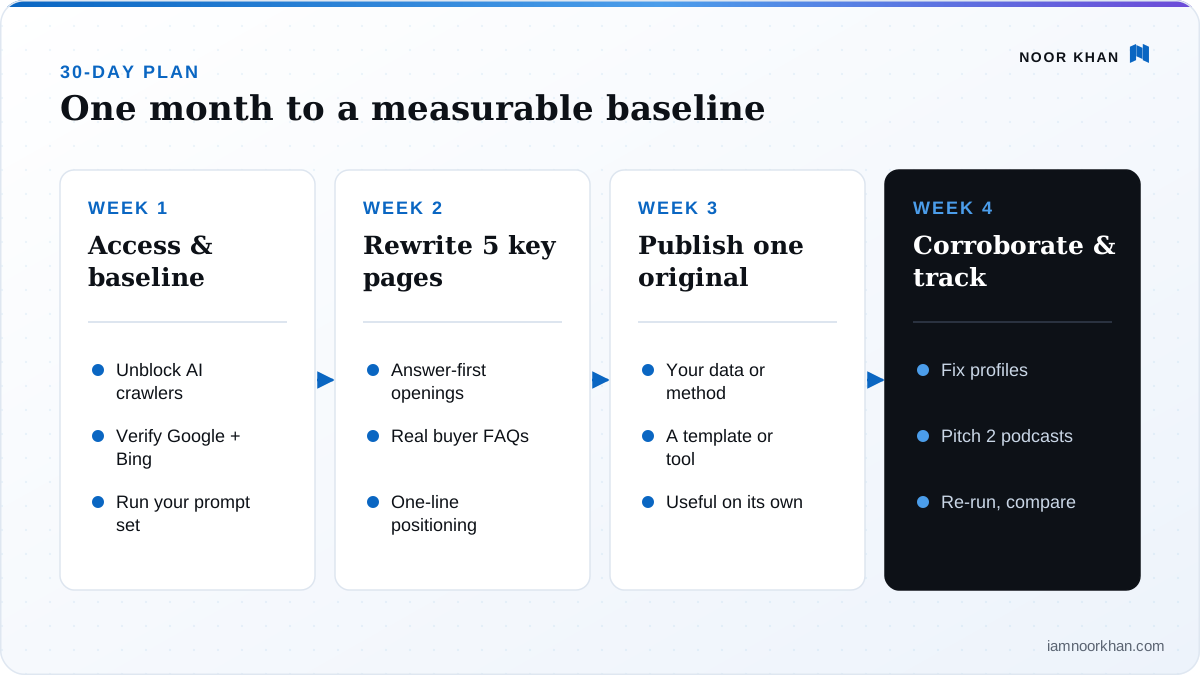
Week 1: Access and baseline
- Day 1–2: Check robots.txt, CDN bot settings and your firewall for blocked AI crawlers. Fix anything that blocks the search crawlers you want.
- Day 3: Verify your site in Google Search Console and Bing Webmaster Tools and submit your sitemap to both. Confirm Settings → Search generative AI is set to include your site.
- Day 4–5: Write 20 buyer questions and run them in ChatGPT, Google AI Mode, Perplexity and Copilot. Record who's named and cited. This is your baseline.
Week 2: Rewrite your five most important pages
- Pick the pages closest to revenue: home, main service or product pages, pricing, about.
- Rewrite every section opening answer-first.
- Add a one-sentence positioning statement: what you do, for whom, where, and what makes you different.
- Add a short FAQ built from questions customers actually ask on calls.
Week 3: Publish one piece of non-commodity content
- Turn something only you know into a page: data from your work, a teardown, a method, a template.
- Cite your sources, show the author, and make it useful even to someone who never hires you.
Week 4: Corroborate and measure
- Fix inconsistent profiles (Google Business Profile, LinkedIn, directories, social bios).
- Ask five happy customers for a review on the platform your buyers trust most.
- Pitch yourself to two podcasts or expert roundups in your niche.
- Set up the GA4 AI channel, re-run your 20 questions and compare with week 1.
Then repeat monthly. AI visibility compounds like reputation does, because it largely is reputation.
Free resource: AI search readiness checklist
Score your site honestly: 1 point for each item you can tick. 20–25 means strong foundations, so focus on substance and corroboration. 12–19 means fix the gaps in order. Under 12 means start with Access and Clarity.
Access
- Key pages indexed in Google (URL Inspection)
- Site verified in Bing Webmaster Tools, sitemap submitted
- OAI-SearchBot, PerplexityBot, Claude-SearchBot not blocked in robots.txt
- No CDN or firewall rule blocking AI search crawlers
- Main content is real text in the HTML
Clarity
- Homepage states what you do, for whom, in one sentence
- Every product or service has its own page
- Section openings answer their headings on their own
- Headings phrased the way customers ask
- Comparisons in tables, processes in numbered lists
Substance
- At least one page with original data or first-hand results
- Prices, timelines or ranges stated where buyers expect them
- Clear recommendations, including when not to choose you
- Claims linked to sources
- A genuinely useful free asset (template, calculator, checklist)
Trust
- Named author with credentials on expert content
- About page with who, what, since when, for whom
- Organization or Person schema with official profile links
- Visible "last updated" dates backed by real updates
- Consistent facts across all pages
Corroboration
- Reviews on the platforms your buyers use
- Accurate listings on key industry directories
- Mentions on at least five independent sites in the last year
- Consistent name and description on every profile
- AI assistants describe you accurately (checked this month)
Free prompt: audit your site's AI search readiness
Paste this into ChatGPT or Claude (with web search on), fill in the brackets, and add the text of your homepage and one key page. It won't predict any algorithm, but it gives you an honest, structured second opinion.
You are a senior SEO and AI search strategist. Audit how ready my business is to be found, cited and recommended by AI search tools (Google AI Overviews and AI Mode, ChatGPT search, Perplexity, Copilot). Be direct, specific and practical.

About my business:
- Name and website: [name, URL]
- What we offer: [products/services]
- Who it's for: [ideal customer, location, size, budget]
- Main competitors: [2-3 names]
- The questions buyers ask before choosing us: [3-5 questions]

Homepage text:
"""
[paste]
"""

Key page text (service, product or pricing page):
"""
[paste]
"""

Please do the following, using web search where helpful:
1. Search for my brand and summarize what the web says about us. List the sources you found, and note anything missing, outdated or contradictory.
2. Ask yourself each buyer question above and tell me honestly whether you would mention us, and why or why not. Name the brands and sources you would rely on instead.
3. Score my two pages from 1-5 on each pillar (Access, Clarity, Substance, Trust, Corroboration) with one sentence of evidence per score.
4. Rewrite the three weakest section openings answer-first, using only facts in my text.
5. List what original information (data, examples, experience) would make my pages more citable than my competitors'. Be specific to my business.
6. Give me a prioritized 10-item action list: what to do, why it matters for AI search, and the effort involved (low/medium/high).

Rules: Don't invent facts, statistics, reviews or sources. If you can't verify something, say so. If you need information from me, list the questions at the end.
How to get the most from it: run it once per main competitor too (swap in their URLs) and compare the scores. The gaps between you and the brands AI already recommends are your roadmap.
Where to go from here
Each of these guides goes deeper on one part of the work:
- How to get cited in Google AI Overviews and AI Mode: eligibility, fan-out coverage and page-level rewrites
- How to get your business recommended by ChatGPT: brand clarity, mentions and fixing what AI gets wrong about you
- How to measure AI search visibility: free reports, a tracker and a monthly scorecard
- How to structure content for AI search: the answer-first method, section by section
- SEO vs AEO vs GEO: how the three disciplines fit together
- AI crawlers and robots.txt: which bots to allow, with copy-paste templates
And if you'd rather have someone look at your site with you, send me your URL for a free written gap snapshot. I'll show you where you're visible in AI search today and the first three things I'd fix. You can also read how I approach this work on my AI search optimization page.
Frequently asked questions
What is AI search optimization?
AI search optimization is the practice of making your content and brand easy for AI-powered search tools (Google AI Overviews and AI Mode, ChatGPT search, Perplexity, Copilot, Gemini and Claude) to find, understand, trust and cite. It builds on SEO and adds a focus on quotable answers, original information, brand mentions across the web, and new ways of measuring visibility.
Is GEO different from SEO, or is it just a new name?
Mostly it's SEO with a different emphasis. The same foundations decide whether you're found: indexable pages, relevance and authority. What changes is what gets you chosen once you're found: answers that work out of context, information nobody else has, and a brand that other sites corroborate. Treat GEO as a layer on top of SEO, not a replacement.
Will AI Overviews and ChatGPT kill my organic traffic?
They're reducing clicks for many informational questions: Pew Research found people clicked a result on 8% of visits with an AI summary versus 15% without. But visibility inside AI answers still drives brand awareness and later visits, and queries that need tools, comparisons, prices or expert help still send traffic. The response is to shift effort toward content and pages that earn the click or the recommendation, and to measure AI visibility, not just clicks.
Do I need llms.txt, special schema or an 'AI version' of my site?
No. Google says you don't need new machine-readable files, AI text files or special markup to appear in its AI features, and that llms.txt doesn't affect Google Search. Other AI companies haven't committed to using llms.txt either. Structured data is still useful for search in general, but it isn't an AI shortcut.
How long does it take to start appearing in AI answers?
Fixes to crawl access and page structure can show up within a few weeks, once pages are recrawled. Being named or recommended for competitive questions usually takes several months, because it depends on reputation and mentions that build gradually.
Can a small business or new website compete in AI search?
Yes, often more easily than in classic rankings, because AI answers frequently cite pages outside the top ten results when they answer a specific sub-question well. Small businesses win by being specific: a clear niche, genuine expertise, detailed answers to real customer questions, and consistent reviews and mentions in their market.
Which AI platform should I prioritize?
Start where your buyers already are: for most businesses that's Google (AI Overviews and AI Mode) and ChatGPT. The foundations are shared, so work done for one helps the others. Then check Perplexity, Copilot and Gemini monthly and fix gaps platform by platform.
Keep reading
 podcast · 14 min
Peter Rota on What Actually Changes in AI Search
Is GEO just SEO with a new name? Peter Rota (HUB International) on falling clicks, structuring content for AI answers and the first 3 moves on a new site.
· with Peter Rota
podcast · 14 min
Peter Rota on What Actually Changes in AI Search
Is GEO just SEO with a new name? Peter Rota (HUB International) on falling clicks, structuring content for AI answers and the first 3 moves on a new site.
· with Peter Rota
 AI Search
AI Crawlers and robots.txt: Which Bots to Allow or Block (With Copy-Paste Templates)
Blocking the wrong AI bot can quietly remove you from ChatGPT or Perplexity answers. Here's what each crawler does, how to decide for your business, three copy-paste robots.txt setups, and how to check it's working.
· 9 min read
AI Search
AI Crawlers and robots.txt: Which Bots to Allow or Block (With Copy-Paste Templates)
Blocking the wrong AI bot can quietly remove you from ChatGPT or Perplexity answers. Here's what each crawler does, how to decide for your business, three copy-paste robots.txt setups, and how to check it's working.
· 9 min read
 AI Search
How to Get Cited in Google AI Overviews and AI Mode (A Practical Playbook)
Google has now said clearly what AI Overviews and AI Mode need. This playbook turns it into steps: eligibility checks, finding your opportunities, covering fan-out questions, rewriting pages so they get quoted, and tracking the results.
· 14 min read
AI Search
How to Get Cited in Google AI Overviews and AI Mode (A Practical Playbook)
Google has now said clearly what AI Overviews and AI Mode need. This playbook turns it into steps: eligibility checks, finding your opportunities, covering fan-out questions, rewriting pages so they get quoted, and tracking the results.
· 14 min read