Semantic Content Brief Template (With a Worked Example)
If your writers keep handing back pages that look finished but don't perform, the brief is usually where it went wrong. Here's the template I use, filled in end to end.
 By Noor Khan
Key takeaways
- A semantic brief tells the writer what the page must say and add, not just which keyword to use.
- Replace word-count targets with coverage criteria: Google says plainly it has no preferred word count.
- Every brief needs an information gain field: the one thing this page adds that the top results don't.
- Only 37% of B2B marketers have a documented content strategy (CMI, 2025 outlook). A brief is that strategy, one page at a time.
- Use Google's people-first questions as the sign-off checklist, so quality is checked before publishing, not after a traffic drop.
Part of the Semantic SEO: A Practical Guide to Ranking by Meaning, Not Keywords series.
Most content briefs I'm handed when I start with a new client look the same: a keyword, a word count, and three competitor URLs. The writer guesses at everything else. The result is a page that looks complete, reads fine, and then sits on page three, never quoted by an AI answer and never converting anyone.
That isn't the writer's fault. A semantic content brief fixes the problem upstream by telling the writer what the page must say, what it must add, in what order, and how it connects to the rest of the site. Below is the exact template I use, a filled-in example for a healthcare page, and the checklist I sign every draft off against.
What is a semantic content brief?
A semantic content brief is a writing brief built around meaning rather than keywords: it defines the page's single search intent, the questions to answer in order, the entities and attributes to cover, what the page adds that others don't, and the internal links it needs. Keywords still appear, but as evidence of how people search, not as the plan itself.
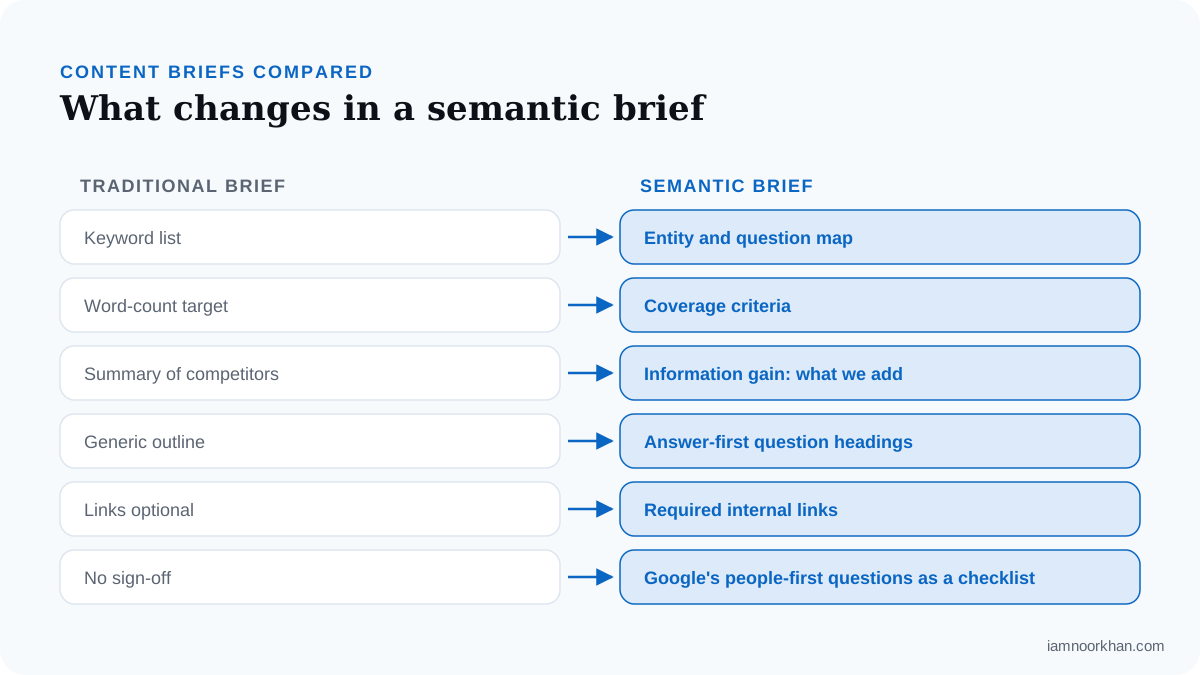
The difference shows up most in six fields. Here's how a traditional brief and a semantic brief handle each one:
| Traditional brief | Semantic brief |
|---|---|
| Keyword list | Entity and question map |
| Word-count target | Coverage criteria |
| Summary of competitors | Information gain: what we add |
| Generic outline | Answer-first question headings |
| Links optional | Required internal links, in and out |
| No sign-off | Google's people-first questions as the acceptance checklist |
If you're new to the method behind this, my semantic SEO guide explains how search engines read meaning. This article is the practical piece: the document your writer actually works from.
Why briefs matter more than they used to
Briefs matter because a writer's hours are limited and a vague brief spends them on guesswork and rewrites. A few numbers make the case:
- 37% of B2B marketers have a documented content marketing strategy, and another 38% have a strategy that isn't written down, according to the Content Marketing Institute's B2B research, Outlook for 2025.
- 3 hours 25 minutes is the average time spent writing a blog post, down from just over four hours in 2022, in Orbit Media's 2025 blogger survey of 808 content marketers, as reported by MarketingProfs.
- 1,333 words is the average post length in that same 2025 survey.
- 21% of bloggers in the Orbit survey report strong results, while 39% of those publishing posts of 2,000+ words do.
- No preferred word count: Google's helpful content guidance asks whether you're writing to a word count because you've heard Google prefers one, and answers: "(No, we don't.)"
Two of those numbers seem to pull in opposite directions, so a word on them. Longer posts correlating with better results doesn't mean length causes results. My reading, from client work, is that longer posts are usually the ones where someone did the research and had something to say. The brief is where you plan that research. Length is what you get when the page covers what it needs to; it shouldn't be the target.
And that 37% figure is the one I'd sit with. Most teams have a strategy in someone's head. A brief is the strategy written down, one page at a time.
The six parts of a semantic brief
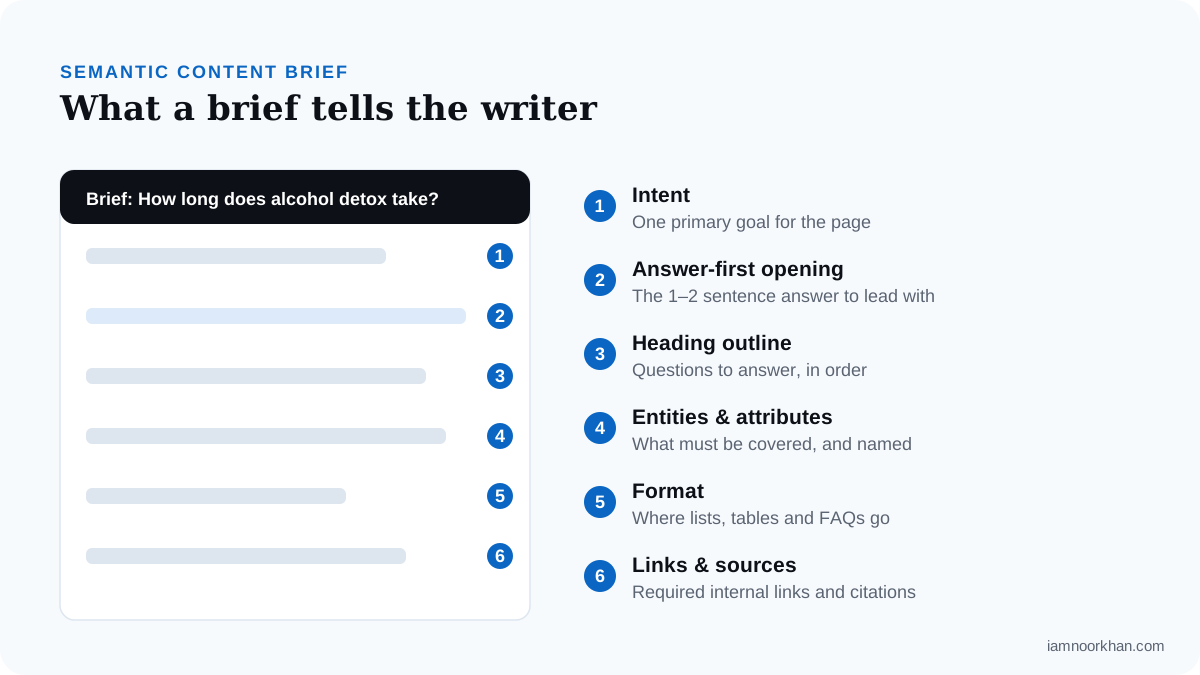
A good brief has six parts: intent and position, an answer-first opening, a question outline, an entity map with coverage criteria, information gain with experience, and links with sign-off. Each one closes a gap a writer would otherwise fill by guessing.
1. Intent and position in the topical map
The brief starts by naming one intent and where the page sits in your topical map. One page, one job. If you find yourself writing "and also" in the intent field, you have two pages. Knowing the parent page and section (core or outer) tells the writer how deep to go and what not to repeat. If you don't have a map yet, start with how to build a topical map.
2. Answer-first opening
The brief includes the one or two sentences that answer the main question directly, ready to paste in as the first paragraph. Writers default to a warm-up intro, and the answer ends up buried in paragraph four. As Peter Rota put it on my podcast, "Get your most important content early, versus burying it in the middle of the page like people were doing five years ago." (Listen to the episode.)
3. Question headings, in order
The outline is a list of questions, ordered from the main answer to supporting detail, and each heading comes with a note on what its first sentence must say. That turns every section into a self-contained passage, which is what both Google and AI assistants pull from. I go deeper on this in how to structure content for AI answers.
4. Entity map and coverage criteria
The entity map lists the things the page must name (concepts, products, conditions, people, places) and the attributes readers expect for each, such as cost, duration, risks or steps. Coverage criteria replace the word-count target: a short list of "the page is complete when it…" statements. A writer can check those. They can't check "2,500 words" against anything except a counter.
5. Information gain and first-hand experience
This field says what this page adds that the top results don't: your data, a worked example, a framework, a photo, a clinician's explanation. I'll be careful here, because information gain gets overstated. Google holds a patent called "Contextual estimation of link information gain", originally filed in 2018 with a continuation granted in June 2024, describing a score for the "additional information included in the document beyond information contained in documents previously viewed by the user." Search Engine Journal's write-up on the patent notes it's framed largely around automated assistants.
A patent shows what Google has explored, not what it uses to rank pages, and Google hasn't confirmed information gain as a ranking factor. I don't need it to be one. Google's own self-assessment questions ask whether content provides "original information, reporting, research, or analysis" and "substantial value when compared to other pages in search results." That's reason enough to make it a required field.
The experience half of the field captures what only a real practitioner knows. It ties directly to E-E-A-T: who is the subject matter expert, what will the writer ask them, and what original material (screenshots, data, photos, quotes) must be collected before drafting starts.
6. Links, sources and sign-off
The brief lists the internal links the page must include, the pages that must link to it once it's live, the sources to cite, and the acceptance checklist. A page with no planned links is an orphan on day one. The checklist is where Google's people-first questions come in, and it's covered in full below.
The copy-paste semantic content brief template
Copy this into your doc tool or project manager and fill in one per page. The prompts in brackets tell you what belongs in each field.
SEMANTIC CONTENT BRIEF

1. PAGE AND INTENT
Working title / H1:        [phrased the way people search]
URL:                       [/section/slug]
Primary intent:            [the one job this page does, in one sentence]
Reader and situation:      [who is searching, and what's going on for them]
Topical map position:      [core or outer section; parent page]
Must NOT cover:            [topics that belong on other pages]

2. ANSWER-FIRST OPENING
[1-2 sentences that answer the main question on their own.
 Writer pastes this in as the first paragraph.]

3. QUESTION OUTLINE (in order)
H2: [question]   First sentence must say: [the direct answer]
  H3: [question] First sentence must say: [...]
H2: [question]   First sentence must say: [...]
...
FAQ (genuine questions only, 4-7): [from People Also Ask, sales calls, support]

4. ENTITY AND ATTRIBUTE MAP
Central entity:            [the main thing the page is about]
Related entities:          [concepts, products, conditions, people, places]
Attributes to cover:       [cost, duration, steps, risks, eligibility...]
Questions per attribute:   [what readers ask about each one]

Coverage criteria (replaces word count):
[ ] The page is complete when it... [answers X]
[ ] ... [explains Y with a table/example]
[ ] ... [tells the reader the next step]

5. INFORMATION GAIN AND EXPERIENCE
What the top 5 results all say:    [the baseline we must match]
What they miss or get wrong:       [the gap]
What we add (pick at least one):   [original data / worked example /
                                    framework / expert explanation /
                                    original images / tool]
Subject matter expert:             [name, role, credentials]
SME interview questions:           [3-5 questions only they can answer]
Original material to collect:      [photos, screenshots, data, quotes]

6. FORMAT
Use a table for:          [...]
Use numbered steps for:   [...]
Callouts / warnings:      [...]
Diagram or image:         [what it must show]

7. LINKS AND SOURCES
Must link to:             [parent page + next logical step (service/contact)]
Glossary terms to link:   [2+]
Sibling articles:         [1-3]
Must be linked from:      [existing pages to update once live]
Sources to cite:          [primary sources for every factual claim]
Reviewer (YMYL topics):   [who reviews, and their credentials]

8. ACCEPTANCE CHECKLIST (editor signs off on each)
[ ] Does the content provide original information, reporting,
    research, or analysis?
[ ] Does it provide a substantial, complete, or comprehensive
    description of the topic?
[ ] Does it provide insightful analysis or interesting information
    that is beyond the obvious?
[ ] Does it provide substantial value when compared to other pages
    in search results?
[ ] Does the main heading or page title provide a descriptive,
    helpful summary of the content?
[ ] Does it clearly demonstrate first-hand expertise and a depth
    of knowledge?
[ ] After reading, will someone leave feeling they've learned enough
    about a topic to help achieve their goal?
[ ] Is it clear who wrote it (byline) and who reviewed it?
[ ] Was any length set by coverage, not a word count?
[ ] Answer-first: does every heading's first sentence answer it?
[ ] Are all planned internal links in place, with descriptive anchors?
The questions in section 8 are quoted from Google's Creating helpful, reliable, people-first content page, lightly shortened to fit a checklist. Google frames them as self-assessment questions, not ranking rules, which is exactly why they work as an editor's sign-off.
Worked example: "How long does alcohol detox take?"
Here's the template filled in end to end for an addiction treatment center, the kind of page I brief often in healthcare work. It's a YMYL ("Your Money or Your Life") topic, so notice how much of the brief is about review and sourcing.
Clinical statements in this example are placeholders for the center's medical team to write and approve. A brief should never ask a writer to invent medical guidance.
| Field | Filled in |
|---|---|
| Working title / H1 | How Long Does Alcohol Detox Take? A Day-by-Day Timeline |
| URL | /alcohol-detox/how-long-does-alcohol-detox-take |
| Primary intent | Understand the alcohol detox timeline and whether it's safe to detox without medical support |
| Reader and situation | Someone thinking about stopping drinking, or a family member worried about a loved one; often anxious, often searching late at night |
| Topical map position | Outer section, supporting the core "Alcohol detox" service page |
| Must not cover | Long-term rehab program details (own page), insurance specifics (own page), drug detox (separate pages) |
| Answer-first opening | Draft from the existing site copy, for clinical review: "Alcohol detox usually takes about a week, with the most intense symptoms in the first few days. Because withdrawal can be dangerous, medical supervision is recommended." |
| Question outline | H2 How long does alcohol detox take? · H2 What happens in the first 24 hours? · H2 What happens on days 2–3? · H2 What happens on days 4–7? · H2 What affects how long detox takes? · H2 Is it safe to detox from alcohol at home? · H2 What happens after detox? · FAQ |
| First-sentence notes | Each stage heading opens with what the person is likely to feel and when to seek help, in plain language, written by the clinical team |
| Central entity | Alcohol detox (alcohol withdrawal management) |
| Related entities | Alcohol withdrawal syndrome, delirium tremens, seizures, medically supervised detox, inpatient vs outpatient detox, medications used in detox, aftercare, residential treatment |
| Attributes | Duration, stages, symptoms by stage, risk factors, safety, setting options, what comes next |
| Coverage criteria | Complete when it: gives the overall timeline in the first paragraph; shows stages in a table; explains which factors make detox longer or riskier; states clearly when to seek emergency care; explains what happens after detox; offers a next step for the reader and for a family member |
| Top 5 all say | A generic 6–72 hour symptom timeline in near-identical wording |
| They miss | What a day in the center's detox unit actually looks like; what families can do; what happens on the day of admission |
| Information gain | A "your first 72 hours with us" walkthrough written with the medical director; an admission-day checklist; original photos of the detox rooms (with permission) |
| SME | The center's medical director (name and credentials on the page as reviewer) |
| SME questions | What do patients most often misunderstand about detox? · What tells your team someone needs a higher level of care? · What does admission day look like, hour by hour? · What should a family member bring or do? |
| Format | Stage timeline table; emergency-symptoms callout near the top; numbered admission-day steps; FAQ |
| Must link to | Alcohol detox service page (parent); insurance verification page; admissions contact |
| Must be linked from | Alcohol addiction guide; "how to help a loved one" article; detox FAQ page |
| Sources | Government health agency and peer-reviewed clinical sources chosen by the reviewer; every clinical claim cited |
| Reviewer | Medical director, shown as "Medically reviewed by" with date |
| Sign-off | Editor completes section 8; medical director approves all clinical statements before publishing |
A few things this brief does that a keyword brief wouldn't. It tells the writer what not to cover, so the page doesn't cannibalize the rehab or insurance pages. It defines "done" as six checkable statements rather than a length. And the information gain comes from something no competitor can copy: the center's own process, explained by its own clinician.
This is the same brief format I use across healthcare engagements, including the work with addiction recovery centers where qualified leads grew 180%. The brief alone didn't do that; the topical map, technical fixes and links mattered too. But it's where every page started. If you work in this space, addiction treatment SEO and E-E-A-T for healthcare websites cover the rest.
How to fill in a brief in about an hour
You can fill in a solid brief in roughly an hour once your topical map exists. Here's the order I work in:
- Pull the intent from the map. The map already says what this page is for and where it sits. Write that sentence first.
- Read the top results, then write what they all say. That's your baseline, not your outline.
- Collect real questions. People Also Ask, sales calls, support tickets, intake forms. Order them the way a reader would ask them.
- Map entities and attributes. List what must be named and what readers expect to learn about each one.
- Decide the information gain. If you can't name one thing the page adds, stop and find it before briefing the writer.
- Book the SME. Write the interview questions into the brief so the writer arrives prepared.
- Plan the links. Parent, next step, glossary terms, siblings, and the existing pages you'll update to link in.
- Write the answer-first opening yourself. It's the hardest two sentences on the page, and the most important.
Common brief mistakes (and the fix for each)
Most brief problems come from leaving a strategic decision to the writer. These are the ones I see most:
- Copying the competitors' outline. You get their page with your logo on it. Fix: use competitors as the baseline in section 5, not as the outline.
- A word-count target. Writers pad to hit it. Fix: coverage criteria.
- Two intents in one brief. The page half-serves both. Fix: split it, and use "Must not cover" to keep the line clear.
- No planned links. The page launches as an orphan. Fix: required links in and out, including the existing pages you'll update.
- No expert input on YMYL topics. Fix: name the reviewer in the brief, before drafting, not after.
- No sign-off. Quality gets judged by gut feel. Fix: the acceptance checklist, every time.
Briefs and AI search
A semantic brief makes a page easier for AI assistants to use, because answer-first headings, clear entities and self-contained passages are what those systems retrieve. I can't promise any page will be cited by an AI tool, and nobody honestly can. What I can say is that pages built from briefs like this one give those systems clean, quotable passages to work with. If AI visibility is your main concern, SEO vs AEO vs GEO explains how the pieces fit.
Where to go from here
A brief is where strategy turns into words on a page. If your team keeps publishing pages that look fine but don't move, the fix usually isn't a better writer. It's a clearer brief, written from a map.
Copy the template, try it on your next page, and see how much less back-and-forth you get. If you'd like a topical map and a full set of briefs built for your site, that's my topical maps and content briefs service. And if you'd rather start by seeing where your coverage has gaps, ask for a free gap snapshot on the contact page.
Frequently asked questions
What should a content brief include?
At minimum: the page's single intent, where it sits in your topical map, the answer it opens with, the questions to cover as headings in order, the entities and attributes to name, what the page adds that competitors don't, the internal links in and out, sources, and a sign-off checklist. Keyword data belongs in the brief as evidence, not as the whole brief.
What is the difference between an SEO content brief and a semantic content brief?
A typical SEO content brief is built around a keyword list, a word count and a summary of competitors. A semantic content brief is built around meaning: the entities and questions the page must cover, coverage criteria instead of a length target, a required information gain, and planned internal links.
How long should a content brief be?
Usually one to two pages. It should be long enough that a writer can work without guessing, and short enough that they actually read it. If a brief runs much longer, it's often trying to serve two intents and should be split into two pages.
Who should write the content brief?
Whoever understands the strategy: usually the SEO or content strategist, with input from a subject matter expert. The writer should be able to ask questions about it, but they shouldn't have to make the strategic decisions about intent, scope and links themselves.
Does Google have a preferred word count?
No. Google's helpful content guidance lists writing to a particular word count as a warning sign and says directly that it has no preferred word count. The right length is whatever it takes to cover the questions the page has to answer.
Can AI tools write content briefs?
AI tools are useful for gathering questions, entities and competitor patterns. The decisions that make a brief work (which intent to serve, what to leave out, what only your business can add, and where the page fits in your site) still need someone who knows the business and its audience.
Keep reading
 AI Search
How to Get Your Business Recommended by ChatGPT and AI Assistants
If you've watched competitors get named by ChatGPT while your business doesn't come up, you're not doing anything wrong. You just can't see how these answers get put together yet. This guide shows you how they work and what you can actually control.
· 12 min read
AI Search
How to Get Your Business Recommended by ChatGPT and AI Assistants
If you've watched competitors get named by ChatGPT while your business doesn't come up, you're not doing anything wrong. You just can't see how these answers get put together yet. This guide shows you how they work and what you can actually control.
· 12 min read
 Healthcare SEO
Addiction Treatment SEO: How Rehab Centers Win Admissions from Search
The people searching for treatment are often frightened, exhausted and searching on behalf of someone they love. This guide shows how a rehab center earns their trust in search, honestly and within the rules.
· 12 min read
Healthcare SEO
Addiction Treatment SEO: How Rehab Centers Win Admissions from Search
The people searching for treatment are often frightened, exhausted and searching on behalf of someone they love. This guide shows how a rehab center earns their trust in search, honestly and within the rules.
· 12 min read