Semantic SEO · Complete guide
Semantic SEO: A Practical Guide to Ranking by Meaning, Not Keywords
If you've published page after page and still can't rank, the problem is rarely effort. This guide explains how search engines understand meaning, how to tell if your site has a semantic problem, and the step-by-step process I use to fix it.
 By Noor Khan
Key takeaways
- Semantic SEO is building a site around the entities, attributes and questions search engines associate with a topic, so the site is understood as a complete, reliable source on it.
- Google has read meaning for over a decade: Hummingbird affected about 90% of searches in 2013, and BERT helped with 1 in 10 US English searches in 2019.
- 15% of the searches Google sees each day are brand new, so you can't target every query with its own page. Covering the meaning of a topic is how you match queries nobody has typed before.
- Clicks are getting scarcer: 58.5% of US Google searches ended without a click in SparkToro's 2024 study, and Pew found people clicked a result in 8% of visits with an AI summary vs 15% without.
- The process: source context → entity and intent research → topical map → briefs → structure for extraction → internal links → publish and refine.
- The same foundation is what AI assistants retrieve and cite. In Google's Danny Sullivan's words, "Good SEO is good GEO."
If you've published page after page, done the keyword research, followed the checklists, and your site still doesn't rank, I want to say something first: the problem is rarely effort. It's usually that the effort went into the wrong shape.
Most sites are built one keyword at a time. Each page made sense when it was written. Together they look, to a search engine, like a pile of loosely related answers rather than a source that understands a subject. Semantic SEO is how you change that shape. It's the method behind every engagement I take on, and it's also why some sites keep appearing in AI answers while others quietly disappear.
This guide covers what semantic SEO is, the numbers behind the shift, how search engines understand meaning, how to tell whether your site has a semantic problem, and the exact process I use to fix one.
What is semantic SEO?
Semantic SEO is building a website around the entities, attributes and questions that search engines associate with a topic, so the site is understood as a complete, reliable source on that topic. Keywords still matter, but as evidence of how people search, not as the unit you plan around.
The easiest way to see the difference is to compare two plans for the same business, an addiction treatment center:
| Keyword approach | Semantic approach |
|---|---|
| One page per phrase: "alcohol rehab", "alcohol rehab near me", "best alcohol rehab" | One strong page per intent, covering everything that intent needs |
| Length set by competitor word counts | Length set by the questions patients and families actually ask |
| Posts published in whatever order ideas arrive | Pages published in the order a topical map sets |
| Pages that compete with each other for the same queries | Pages that link to and reinforce each other |
| Gains fade as competitors publish similar pages | Gains compound as coverage becomes complete |
Notice what the semantic column doesn't say: it doesn't say "write longer". Google states plainly that it has no preferred word count. Completeness is about covering what the reader needs, not about volume.
Semantic SEO by the numbers
The data points the same way: Google has been reading meaning for years, queries are too varied to target one by one, and clicks are getting harder to earn.
| Statistic | Source |
|---|---|
| Google's Knowledge Graph held 500 billion facts about 5 billion entities by 2020 | Google, 2020 |
| 15% of the searches Google sees every day have never been searched before | Search Engine Land, 2017; repeated by John Mueller in 2025 |
| The average #1 page also ranks in the top 10 for nearly 1,000 other keywords (median around 400) | Ahrefs study of 3 million searches (older data, 2017) |
| 58.5% of US Google searches ended without a click to any result | SparkToro and Datos, 2024 |
| People clicked a traditional result in 8% of visits with an AI summary, versus 15% without one | Pew Research Center, 2025 |
| AI Overviews appeared for 6.49% of queries in January 2025, 24.61% in July and 15.69% in November | Semrush AI Overviews study, 2025 |
Two of these matter most for a business owner. First, the 15% figure: if one in seven daily searches is brand new, no keyword list can cover them. A page that covers the meaning of a topic can still match them. Second, the Ahrefs finding: a strong page doesn't rank for "its keyword", it ranks for a whole family of related queries. That's semantic SEO showing up in the data.
The click numbers are sobering, and I won't pretend otherwise. Zero-click searches mean fewer visits are up for grabs. Ahrefs' 2025 study of 300,000 keywords found that position-one click-through rates were 34.5% lower on keywords with AI Overviews, comparing March 2024 with March 2025. That's a correlation across two sets of keywords, not proof that AI Overviews caused every lost click, but the direction is consistent with Pew's findings. The practical upshot: the visits that remain go to sources that are clearly the best answer, and those are often the sources AI summaries cite.
How search engines understand meaning
Google moved from matching words to understanding meaning step by step, and each step is something you can write for. You don't need to read patents to do semantic SEO well, but knowing the moving parts makes every decision easier.
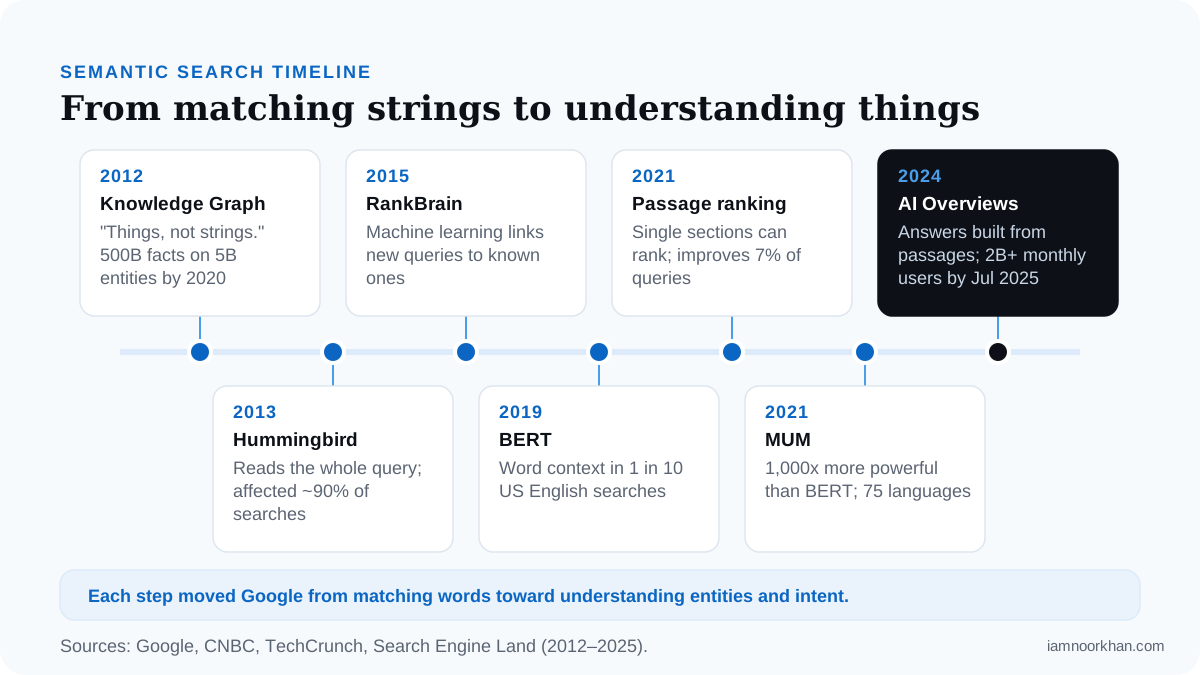
| Year | What changed | What it means for your pages |
|---|---|---|
| 2012 | Knowledge Graph: Google starts modeling real-world entities and their relationships | Be clear about which things a page is about |
| 2013 | Hummingbird: queries interpreted as whole questions, not word lists | Answer the question, not the phrase |
| 2015 | RankBrain: machine learning relates unfamiliar queries to familiar ones | One good page can rank for hundreds of variations |
| 2019 | BERT: understands how combinations of words express meaning and intent | Natural, precise writing beats repeated keywords |
| 2021 | Passage ranking: individual sections can rank for narrow queries | Every section needs to stand on its own |
| 2021 | MUM: a multitask, multilingual model for complex questions | Cover the full journey around a question, not just the first step |
| 2024 onward | AI Overviews and AI assistants assemble answers from passages across sources | Clear, citable passages from trusted sources get used |
The scale of these changes is easy to underestimate. When Google launched Hummingbird in 2013, search chief Amit Singhal said it affected about 90% of searches worldwide (CNBC, 2013). When BERT arrived, Google's Pandu Nayak said it would help Search better understand one in 10 searches in the US in English (TechCrunch, 2019). Google said passage ranking would improve 7% of search queries across all languages once rolled out (Search Engine Land, 2021), and described MUM as 1,000 times more powerful than BERT, trained across 75 languages (Search Engine Land, 2021).
Entities and the Knowledge Graph
An entity is a uniquely identifiable thing: a person, a company, a medication, a condition, a concept. When Google introduced the Knowledge Graph in 2012, it described the shift in three words: "things, not strings". At launch the Knowledge Graph held more than 500 million objects and 3.5 billion facts about them; by 2020, Google reported 500 billion facts about 5 billion entities.
In practice, this means that when someone searches "semaglutide side effects", Google already knows semaglutide is a medication, which class it belongs to, what it's prescribed for, and which questions usually come next. A page that covers those connected facts clearly is easier to understand, and easier to trust, than one that repeats the phrase "semaglutide side effects" ten times.
Language understanding
Google's own guide to its ranking systems describes BERT as understanding "how combinations of words express different meanings and intent", and neural matching as matching "representations of concepts in queries and pages". Put simply: synonyms, word order and context are understood. You don't need to force exact phrases, and doing so usually makes writing worse for the human reading it.
Passages, not just pages
Through passage ranking, Google can rank one section of a long page for a narrow question the rest of the page doesn't address. AI systems go a step further and build answers from passages pulled from several sources at once. This is the single biggest reason structure matters now: a section that only makes sense after reading three others can't be lifted out and used.
Trust at the topic level
Search engines judge sources by how reliably they cover a whole subject, not just how good one page is. That's topical authority, and it's why focused specialist sites so often outrank generalists with far stronger link profiles.
Signs your site has a semantic problem
Before changing anything, it helps to know whether this is actually your problem. These are the patterns I see most often when I audit a site, and each one points to a semantic cause rather than a technical or link problem:
- Several of your pages rank for the same queries, and they take turns appearing. That's keyword cannibalization: Google can't tell which page you consider the answer.
- Your pages appear for very few distinct queries in Search Console. Remember the Ahrefs finding: a strong page can appear for hundreds of variations. Thin or narrow pages appear for a handful.
- New pages take months to get any impressions, even when they're good. Sites with established topical authority usually see new pages in the same topic pick up visibility much faster.
- Your blog covers everything loosely connected to your industry. Posts outside your source context dilute the signal about what you're actually expert in.
- Your most important service or product pages are your thinnest pages, while blog posts carry all the depth.
- AI assistants describe your business vaguely, or not at all, when asked about your specialty.
If three or more of those sound familiar, more content won't fix it. A plan will.
The semantic SEO process, step by step
This is the process I follow with clients. It works for a 20-page clinic site and for a 2,000-page store; only the size of each step changes.
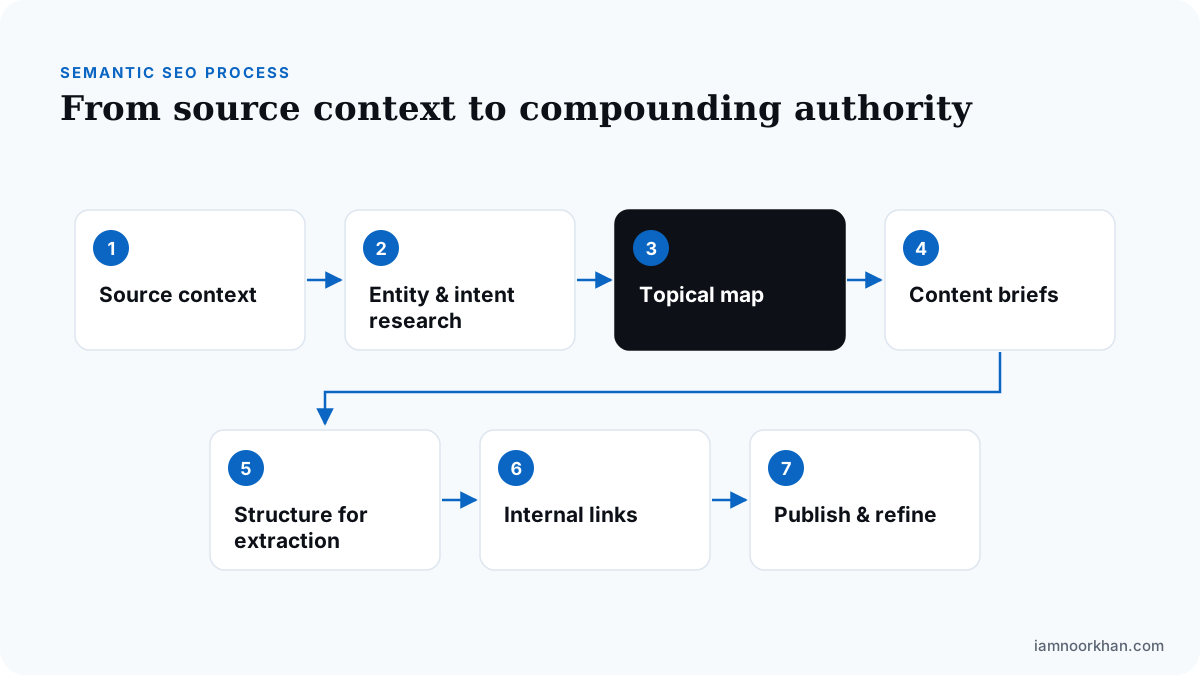
1. Define your source context
Start with what your site is: the business, the main entity, and the angle you cover your topic from. That's your source context, and it decides which pages belong on your site at all.
A detox clinic and a health publisher both write about alcohol withdrawal, but they shouldn't write the same pages. The publisher covers the condition broadly. The clinic covers it from the point of view of someone deciding whether to get help, and what happens when they do. Write your source context as one sentence and test every planned page against it.
2. Research entities and intent
List the central entity and everything connected to it: its attributes, sub-entities, related entities, and the questions people ask at each stage, from "what is this" to "who should I trust with this".
Then look at what the current results reward for each question. The results show what format Google believes satisfies the search intent: a comparison table, a step-by-step guide, a local service page, a definition. If every top result is a guide and you're planning a sales page, the plan needs to change, not the results. People Also Ask boxes and the "related searches" at the bottom of the page are free, honest sources of the questions to cover.
3. Build a topical map
Turn the research into a topical map: every subtopic grouped into pages with one clear intent, split into core sections (closest to revenue: services, products, locations) and outer sections (supporting knowledge that builds the authority those core pages rely on). I walk through this in detail, with a worked example, in how to build a topical map.
The map is also where you decide order. Publish the pages closest to revenue first, then the supporting pages that strengthen them.
4. Brief every page
Each page gets a semantic content brief: the answer-first opening, the questions to cover in order as headings, the entities and facts to include, the format, the one thing this page will add that others don't, and the internal links it must carry. A good brief is what turns a strategy into pages a writer can actually produce well. You can copy mine from the semantic content brief template.
5. Structure for extraction
Write answer-first: the first sentence under each heading should answer that heading on its own. Keep each section self-contained, use lists and tables where the content genuinely is a list or a comparison, and mark pages up with structured data. Google's documentation describes structured data as a way of providing "explicit clues about the meaning of a page". It helps Google read the page; it doesn't replace a good page.
Peter Rota, who runs technical SEO at HUB International, put it simply when we talked on the podcast: "Get your most important content early, versus burying it in the middle of the page." The same structure helps a reader who's skimming on their phone and a machine choosing which passage to quote. The full checklist is in how to structure content for AI answers.
6. Link deliberately
Internal links are how you show search engines the relationships in your map. Supporting pages link up to the main page on their topic; core pages link out to the supporting detail a reader would want next. Use descriptive anchor text that says what the destination is about, and link where it helps the reader in the body of the page, not only in menus and footers.
7. Publish consistently, then refine
Authority builds through steady, complete coverage, not bursts. Publish in map order, watch impressions and query breadth in Search Console, then improve or merge pages that underperform. Update the date only when the content genuinely changes.
A worked example: rebuilding one page
Here's what the process looks like on a single page. Imagine a treatment center with a service page titled "Alcohol Rehab" that has 300 words, three mentions of "best alcohol rehab", a stock photo and a contact form. Two blog posts, "Alcohol Rehab Near Me" and "Choosing an Alcohol Rehab", target nearly the same queries.
Diagnosis: three pages competing for one intent; none of them answers what a frightened family member actually needs to know before calling.
The rebuild:
- Merge the two blog posts into the service page and redirect them, so one URL holds the intent.
- Open with the answer: what the program is, who it's for, how long it lasts and whether insurance is accepted, in the first two sentences.
- Cover the connected entities a family is weighing: medical detox, residential versus outpatient care, length of stay, insurance and cost, what a typical day looks like, family involvement, aftercare. Each becomes a heading that answers one question.
- Add trust: the clinical director's name and credentials, licensing and accreditation, and a reviewed-by line. This is E-E-A-T in practice, and for health topics it isn't optional.
- Link to the detox page, the insurance page and an article on how to help a loved one accept treatment, each with a descriptive anchor.
- Mark up the page with structured data for the organization and the FAQ section where it's genuine.
Here's how the page changes at a glance:
| Before | After | |
|---|---|---|
| URLs targeting the intent | 3, competing | 1, with two redirects |
| Opening | Welcome message | The answer in two sentences |
| Entities covered | "Alcohol rehab" only | Detox, levels of care, length of stay, insurance, daily schedule, family, aftercare |
| Trust signals | None visible | Named clinical director, licensing, reviewed-by line |
| Internal links | Contact form only | Detox, insurance and family-support pages |
Nothing here is a trick. The page simply becomes the most complete, clearly organized answer to the question it exists for. This is the kind of work behind results like +250% organic traffic for Grove Healthcare and +180% qualified leads for addiction recovery centers; you can read more on the healthcare SEO page and in addiction treatment SEO.
Common semantic SEO mistakes
- Treating it as synonyms. "LSI keywords" are still recommended in some popular guides, but Google's John Mueller was blunt in 2019: "There's no such thing as LSI keywords -- anyone who's telling you otherwise is mistaken, sorry." (Search Engine Roundtable, 2019). Adding related words to a page isn't semantic SEO; covering what the topic requires is.
- Volume without a map. Hundreds of disconnected posts create noise, not authority, and often create cannibalization.
- Ignoring existing pages. Merging overlapping pages is frequently the quickest win available, and the most overlooked.
- Drifting off-topic for traffic. Popular posts outside your source context bring visitors who will never become clients, and blur what your site stands for.
- Rewriting what already ranks. Repeating the top ten results adds length, not value. Information gain comes from first-hand experience, your own data, client examples and expert insight.
- Writing for machines first. If a sentence exists only to include a term, the reader notices, and so does every system built to model what readers find helpful.
Key concepts, briefly
You'll meet these terms in any serious semantic SEO work. Each links to a fuller explanation in the glossary.
| Concept | What it means in practice |
|---|---|
| Entity | The "thing" a page is about: a service, a condition, a product, a person |
| Knowledge Graph | Google's database of entities and how they relate |
| Topical authority | Being treated as a dependable source on a whole subject |
| Source context | What your site is and the angle it covers a topic from |
| Topical map | The plan of every page your site needs, and how they connect |
| Search intent | The goal behind a query, which decides what a page must do |
| Information gain | What your page adds that others don't |
| Semantic content brief | Instructions that turn the map into a page a writer can produce |
What semantic SEO looks like for different sites
The principles stay the same; the shape of the work changes:
- Clinics and service businesses: depth on each service, the questions people ask before they call, and visible trust signals. See healthcare SEO.
- E-commerce: category architecture that mirrors how people actually shop, complete product attributes, and buying guides that link to the right categories. See e-commerce SEO.
- SaaS: complete coverage of the problems the product solves, plus use-case, comparison and integration pages for buyers close to a decision. See SaaS SEO.
- Consultants and experts: one clear specialty, an About page that proves it, and content that shows how you think.
How to measure semantic SEO progress
Rankings for one keyword are a poor signal of semantic progress. Look at the topic instead:
- Impressions by topic cluster in Google Search Console, filtered by URL folder or a list of pages.
- Query breadth: the number of distinct queries each page appears for. This is often the first number to move after a rebuild.
- Time to visibility for new pages. As authority builds, new pages in the same topic usually gain impressions faster.
- Mentions in AI answers for the questions your buyers ask. I explain a simple monthly method in how to measure AI search visibility.
- Leads, sales and admissions from organic search, which is the reason for all of it. With fewer clicks to go around, conversions per visit matter more than raw traffic.
A 90-day starting plan
If you want to start on your own, this is a realistic first quarter for a small or mid-sized site:
| Weeks | Focus | Output |
|---|---|---|
| 1–2 | Source context and an audit of existing pages | One-sentence positioning; a list of pages to keep, merge or fix |
| 3–4 | Entity and intent research | A question and entity inventory for your topic |
| 5–6 | Topical map | Core and outer sections, in priority order |
| 7–10 | Rebuild existing core pages | Answer-first pages with trust signals, schema and internal links |
| 11–13 | Publish the first missing core pages | Briefs written; first new pages live |
After that, keep a steady publishing rhythm through the outer sections and review the map every quarter. Steady beats ambitious: two excellent pages a month for a year will do more than twenty rushed ones in a week.
Semantic SEO and AI search
The foundation that builds topical authority in Google is the same thing AI assistants need to find and trust a source: clear entities, complete coverage and passages that make sense on their own. Google's Danny Sullivan said it in five words at WordCamp US: "Good SEO is good GEO" (Search Engine Land, 2025). If the acronyms are new to you, SEO vs AEO vs GEO explains how they fit together.
When I asked Peter Rota whether AI search is a new discipline, his answer was that a strong SEO foundation gets you "80% of the way there"; the rest is about how your brand is described across the wider web. That matches what I see in client work, and it's why I treat AI search optimization as semantic SEO extended, not as a separate project. The full conversation is worth fourteen minutes of your time.
Where to go from here
You don't need to rebuild everything at once. Start with your source context, fix the pages that compete with each other, and let a topical map decide what comes next. Most of the sites I work with already have good material; it just hasn't been given a shape search engines can read.
If you'd like this process applied to your own site, it's exactly what my semantic SEO strategy work covers. And if you just want to know where your site stands first, ask for a free gap snapshot on the contact page.
Frequently asked questions
What is semantic SEO in simple terms?
Semantic SEO is optimizing a website for meaning rather than individual keywords. Instead of writing one page per keyword, you cover the entities, attributes and questions people associate with a topic, in pages that each serve one clear intent. Search engines then understand your site as a complete and reliable source on that topic.
What is the difference between semantic SEO and traditional SEO?
Traditional SEO optimizes individual pages for individual keywords. Semantic SEO plans the whole site around a topic: which pages need to exist, what each one must answer, and how they connect. Keywords still matter as evidence of how people search, but they are inputs to the plan, not the plan itself.
Are LSI keywords part of semantic SEO?
No. Google's John Mueller said in 2019 that "there's no such thing as LSI keywords", and sprinkling related words into a page doesn't make it semantic. What matters is whether the page actually covers the entities, attributes and questions the topic requires, and whether it connects clearly to the rest of your coverage.
What are entities in SEO?
An entity is a uniquely identifiable thing, such as a person, a company, a medication, a place or a concept. Google stores entities and the relationships between them in its Knowledge Graph and uses them to understand what a page is about. Making your main entities clear, and covering how they connect, is the core of semantic SEO.
Does structured data help semantic SEO?
Structured data gives Google what its documentation calls explicit clues about the meaning of a page, and it can make a page eligible for rich results. It doesn't guarantee higher rankings, and it can't rescue a page that doesn't answer the question well. Treat it as a way to label good content clearly, not a substitute for it.
Is semantic SEO still relevant with AI search?
More than ever. Google AI Overviews, ChatGPT and Perplexity build answers from passages taken from sources that cover a topic clearly and reliably. Complete, well-structured coverage with clear entities is exactly what those systems can use and cite, though no one can guarantee a citation.
How long does semantic SEO take to work?
Leading indicators, such as impressions and the number of queries a page appears for, usually move within two to three months. Meaningful business impact usually lands between months four and eight, depending on competition and how much of the topic your site already covers.
Keep reading
 podcast · 14 min
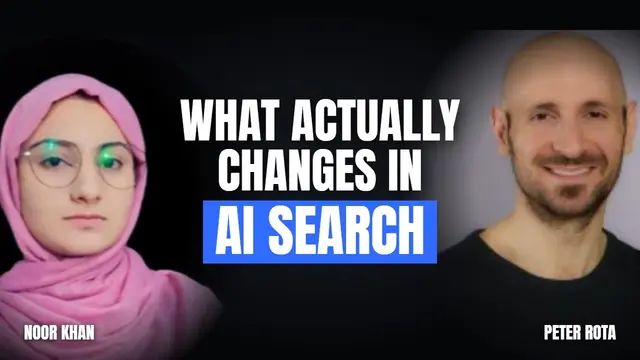
Peter Rota on What Actually Changes in AI Search
Is GEO just SEO with a new name? Peter Rota (HUB International) on falling clicks, structuring content for AI answers and the first 3 moves on a new site.
· with Peter Rota
podcast · 14 min
Peter Rota on What Actually Changes in AI Search
Is GEO just SEO with a new name? Peter Rota (HUB International) on falling clicks, structuring content for AI answers and the first 3 moves on a new site.
· with Peter Rota
 AI Search
How to Get Your Business Recommended by ChatGPT and AI Assistants
If you've watched competitors get named by ChatGPT while your business doesn't come up, you're not doing anything wrong. You just can't see how these answers get put together yet. This guide shows you how they work and what you can actually control.
· 12 min read
AI Search
How to Get Your Business Recommended by ChatGPT and AI Assistants
If you've watched competitors get named by ChatGPT while your business doesn't come up, you're not doing anything wrong. You just can't see how these answers get put together yet. This guide shows you how they work and what you can actually control.
· 12 min read
 Healthcare SEO
Addiction Treatment SEO: How Rehab Centers Win Admissions from Search
The people searching for treatment are often frightened, exhausted and searching on behalf of someone they love. This guide shows how a rehab center earns their trust in search, honestly and within the rules.
· 12 min read
Healthcare SEO
Addiction Treatment SEO: How Rehab Centers Win Admissions from Search
The people searching for treatment are often frightened, exhausted and searching on behalf of someone they love. This guide shows how a rehab center earns their trust in search, honestly and within the rules.
· 12 min read